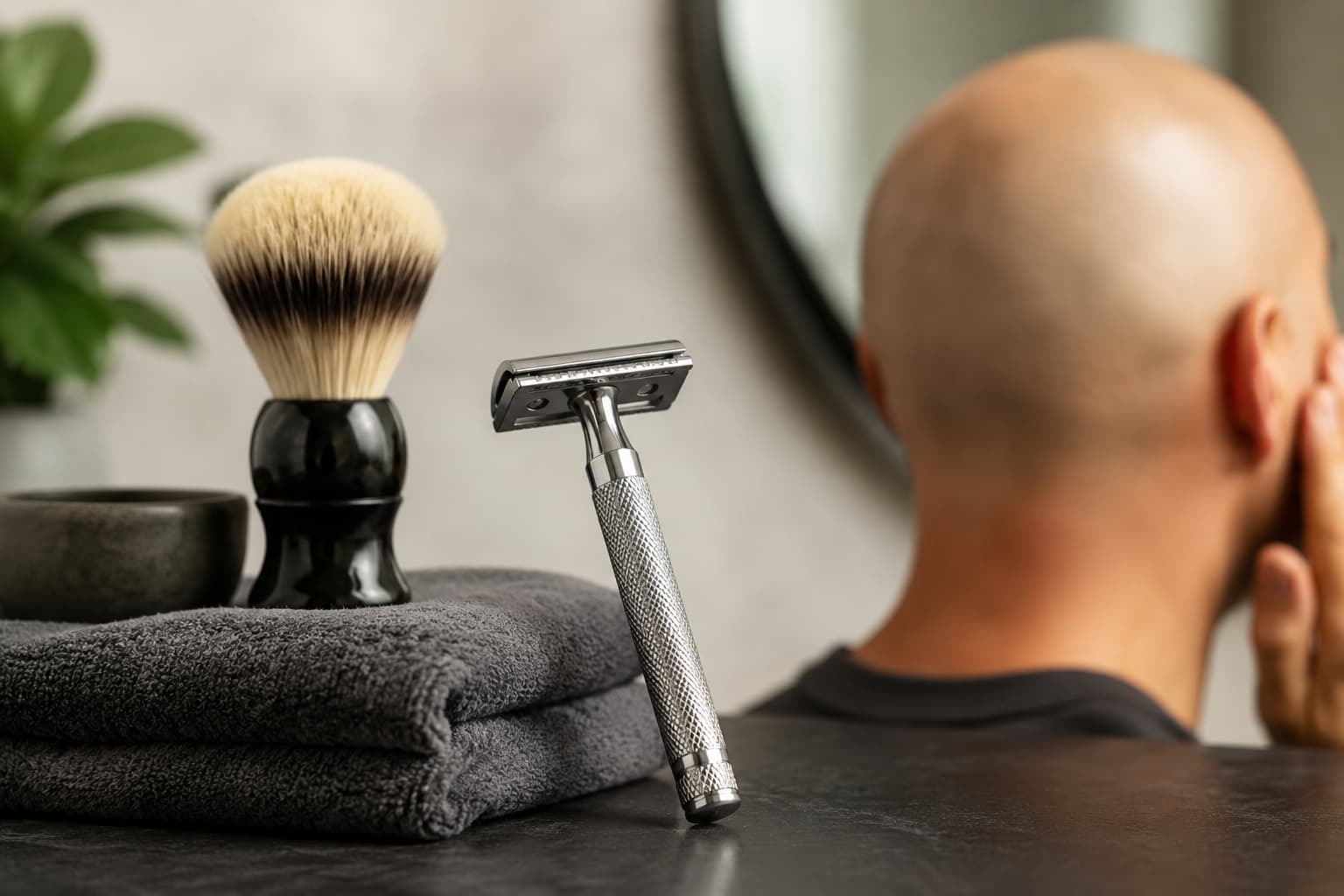
Shaving your head with a safety razor is one of the most rewarding upgrades a bald or close cropped man can make to his grooming routine and also one of the most technically demanding uses of a safety razor. The skull is a curved surface with no flat planes, no consistent angles and areas that are genuinely hard to see without mirrors, the hair is usually coarser and denser than beard hair and the skin at the back and sides is not used to regular razor contact the way facial skin is.
That sounds daunting, but it should not be, because every challenge head shaving presents has a solution and once your technique is set, shaving your head with a good safety razor gives a smoothness and closeness that clippers and cartridge razors cannot match. This guide covers the best safety razor for head shaving at every level, the exact technique adjustments the scalp needs, how to handle the difficult areas and how to build a routine that gives clean results every time.
If you just want the short answer, the best safety razor for head shaving for most beginners is the mild, long handled Merkur 23C, the Merkur 38C is the top choice if you like a heavy razor and the Rockwell 6S is the best adjustable option that grows with your technique.
Quick Picks: Best Safety Razors for Head Shaving 2026
| Razor | Aggressiveness | Handle Length | Weight | Best For |
| Merkur 23C | Mild | 4.0 inches | 71g | Beginners, sensitive scalp |
| Merkur 38C | Mild-Medium | 4.0 inches | 120g | Heavy handle preference |
| RazoRock Game Changer 0.84 | Medium | 3.5 inches | 85g | Intermediate head shavers |
| Rockwell 6S | Adjustable | 3.5 inches | 118g | All levels, versatile |
| Merkur 37C Slant | Medium-Slant | 3.5 inches | 90g | Coarse scalp hair |
| Feather AS-D2 | Mild-Medium | 3.9 inches | 89g | Experienced, daily shave |
| Parker 99R | Mild | 4.0 inches | 95g | Budget head shavers |
Why Safety Razors Are Excellent for Head Shaving
Most men start head shaving with electric clippers or a multi blade cartridge, and both fall short of what a well used safety razor delivers on a shaved head.
The closeness beats clippers, since even the best foil shavers leave visible stubble within hours because of the mechanical gap between foil and blade, while a safety razor cuts at the skin surface with no such gap, so the result looks and feels genuinely smooth rather than closely cropped.
The cost efficiency is significant at scale, because scalp hair is denser and coarser than facial hair, so cartridges that might last a week of face shaving last only two or three head shaves at $3 to $8 each, whereas a DE blade costs 10 to 50 cents, and even changing it every two to three head shaves the yearly cost is a fraction of the cartridge equivalent.
The skin health improves for many men, since the multi blade hysteresis effect that cuts hair below the surface causes the same scalp bumps and ingrown hairs it causes on the face, and a single blade cutting at the surface avoids it, so a lot of men find chronic scalp irritation from cartridge head shaving clears within the first few weeks of switching.
The environmental benefit is even larger for head shaving than face shaving, since head shavers go through more blades, so removing cartridge waste from a head shaving routine eliminates substantially more plastic.
Check the Best Safety Razor for Head Shaving on Amazon
How Head Shaving Is Different from Face Shaving
Understanding the specific challenges before you start is the fastest path to good technique.
The geometry is the first, since a face has flat planes on the cheeks and chin while the skull is almost entirely curved and the curvature changes continuously, so the razor angle relative to the skin changes constantly and every part of the scalp needs a slightly different wrist orientation to hold the roughly 30 degree cutting angle. That constant adjustment is the main new skill head shaving develops.
The visibility is the second, since you can see your face easily but the back of your head needs a second mirror or shaving by feel, and most experienced head shavers use a mirror for the front, top, and sides and shave the back and crown by feel, a skill that develops with practice, so a two mirror setup is the safer approach in the early weeks.
The hair density and coarseness is the third, since scalp hair is usually denser and coarser than beard hair, which makes the blade and razor pairing matter more than for the face, so a mild razor and soft blade that suit a medium beard may feel inadequate on coarse scalp hair.
The skin sensitivity transition is the fourth, since scalp skin that has never met a razor is more reactive at first and usually normalizes within four to six weeks, so during that phase use the mildest razor you have, change blades often, and avoid aggressive passes.
Choosing the Best Safety Razor for Head Shaving
Not every safety razor suits head shaving equally, so here is what to prioritize.
Handle length matters most, since reaching the back and crown needs enough handle to grip comfortably while your arm is in awkward extended positions, so a handle under 3.5 inches makes the back of the head much harder, and 3.8 to 4.2 inches is the sweet spot.
Aggressiveness works a little differently than for the face, since the coarser, denser scalp hair benefits from a mild to medium razor rather than the ultra mild options recommended for face shaving beginners, because a razor that is too mild needs too many passes and accumulates irritation. Aggressive razors are still wrong for beginners though, since a curved surface plus developing technique plus unadapted skin makes them a reliable source of cuts, so start mild to medium and work up.
Weight helps on the scalp, since the larger area and coarser hair benefit from a weight driven zero pressure technique, so razors in the 85g to 120g range suit head shaving well, which is exactly why the heavy Merkur 38C is so popular with head shavers.
Head design is usually a standard closed comb, which works well for most head shavers, though men with especially dense or coarse scalp hair often find a slant razor like the Merkur 37C cuts through it more efficiently thanks to its slicing action.
Best Safety Razors for Head Shaving: Full Reviews
1. Merkur 23C: Best for Beginner Head Shavers
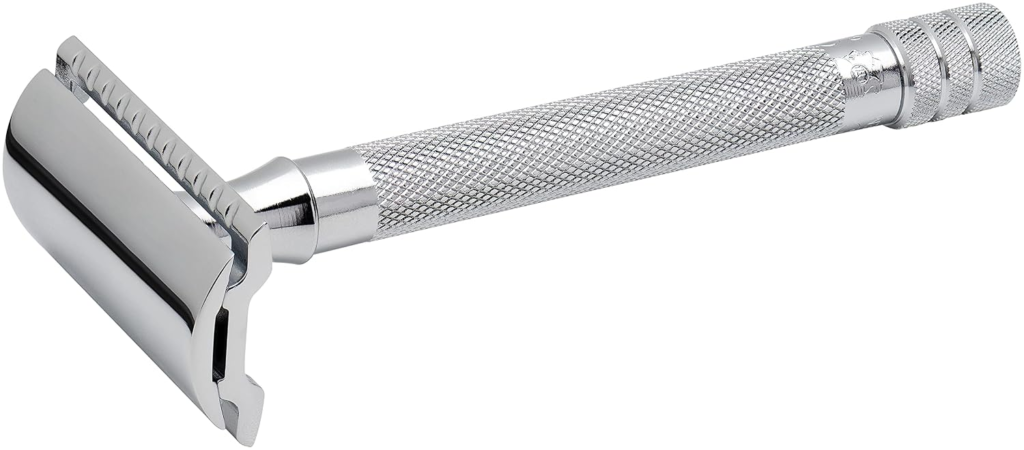
The Merkur 23C is my top pick for men starting head shaving with a safety razor. Its 4 inch handle reaches all scalp areas including the back and crown, and the mild blade gap is forgiving enough for developing technique and transitioning scalp skin. It is the same mild, reliable Merkur quality that makes it a favorite for women’s leg shaving and facial beginners, and for head shaving specifically the long handle plus mild geometry is the safest possible introduction.
Specifications: 71g, 4.0 inch handle, closed comb, chrome plated zinc alloy, mild.
Pros:
- Long handle excellent for scalp reach
- Mild geometry safe for transitioning scalp skin
- Trusted Merkur quality and reliability
- Works with all standard DE blades
- Affordable enough to learn on
Cons:
- Mild gap may struggle with very coarse or dense scalp hair
- Chrome plated zinc less durable than stainless steel
- Not adjustable as your needs grow
- Slightly light compared with heavier head shaving options
Check Merkur 23C Price on Amazon
2. Merkur 38C: Best Heavy Handle for Head Shaving
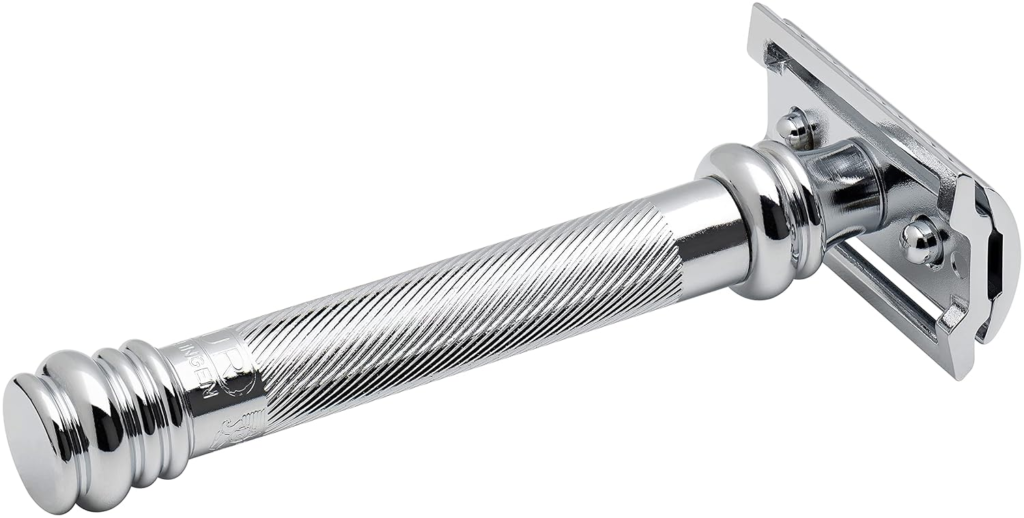
The Merkur 38C is popular in head shaving circles for its 4 inch handle combined with an unusually heavy 120g weight, which carries the razor across the scalp with minimal hand pressure, a real benefit when navigating the curved back of the head where feel is doing most of the work. Its mild to medium head suits coarser scalp hair better than ultra mild options, and the balance feels natural in the overhead and behind head positions head shaving demands. Many committed head shavers describe the 38C as the razor they settled on after trying several.
Specifications: 120g, 4.0 inch handle, closed comb, chrome plated brass, mild to medium.
Pros:
- Heavy weight ideal for zero pressure technique
- Long handle for excellent scalp reach
- Mild to medium geometry suits scalp hair well
- Popular specifically within head shaving communities
- Comfortable in extended overhead positions
Cons:
- Heavy at 120g, which can tire the hand in longer sessions
- Chrome plated brass rather than stainless steel
- Fixed geometry with no adjustability
- Higher price than the 23C for an incremental gain
Check Merkur 38C Price on Amazon
3. RazoRock Game Changer 0.84: Best Mid-Range for Head Shaving
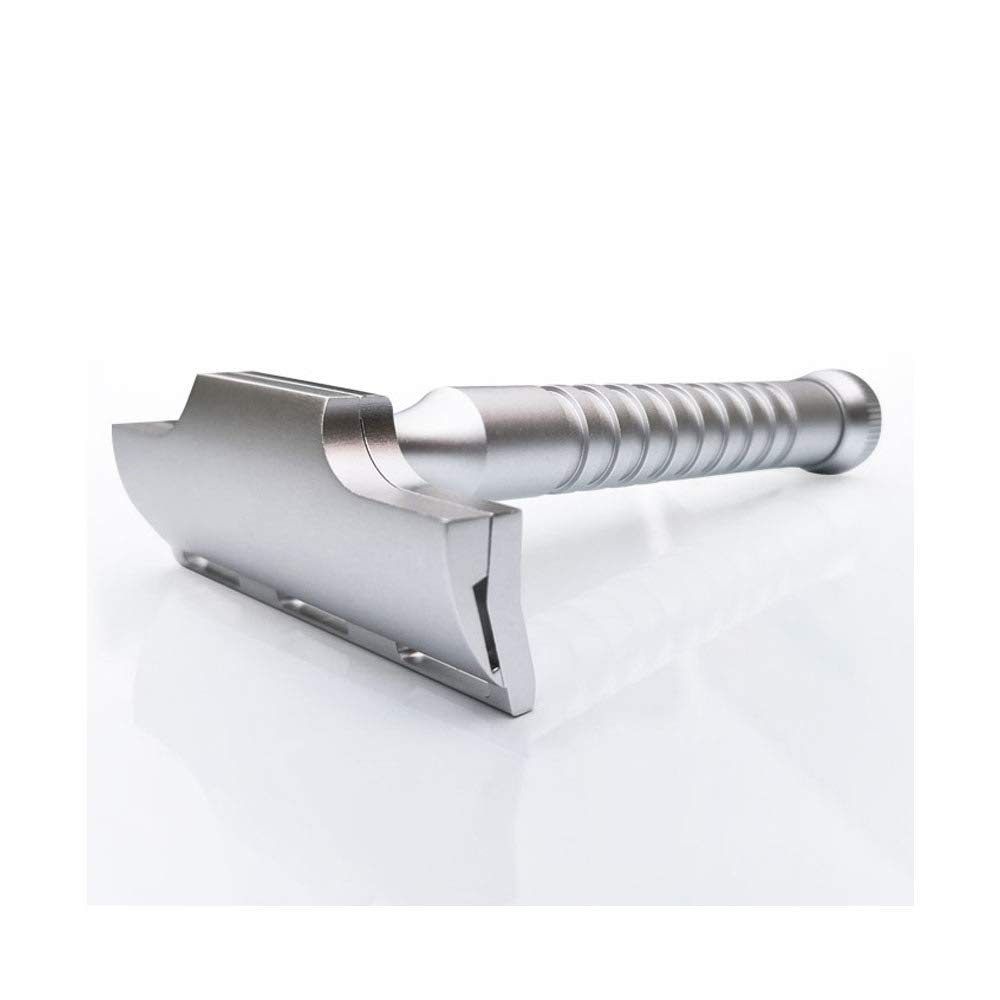
The 0.84mm gap is the configuration the wet shaving community most recommends for head shaving in the Game Changer lineup, sitting in the mild to medium range that is efficient on scalp hair density without being aggressive enough to punish the angle variability of a curved scalp. The stainless steel head with aluminum handle gives a good weight and durability balance well below premium prices, and for intermediate head shavers with a few weeks of experience wanting to move past a mild beginner razor, it is the most widely recommended step up.
Specifications: 85g, 3.5 inch handle, closed comb, stainless steel head with aluminum handle, medium.
Pros:
- The 0.84 gap suits scalp hair density well
- Stainless steel head for durability
- Good weight balance for head shaving positions
- Strong community support for head shaving use
- Excellent value at the mid-range price
Cons:
- 3.5 inch handle slightly short for some scalp reach
- Aluminum handle less premium than full stainless
- Fixed gap means a different razor for a different aggressiveness
- Not ideal for complete beginners coming from clippers
Check RazoRock Game Changer Price on Amazon
4. Rockwell 6S: Best Adjustable for Head Shaving
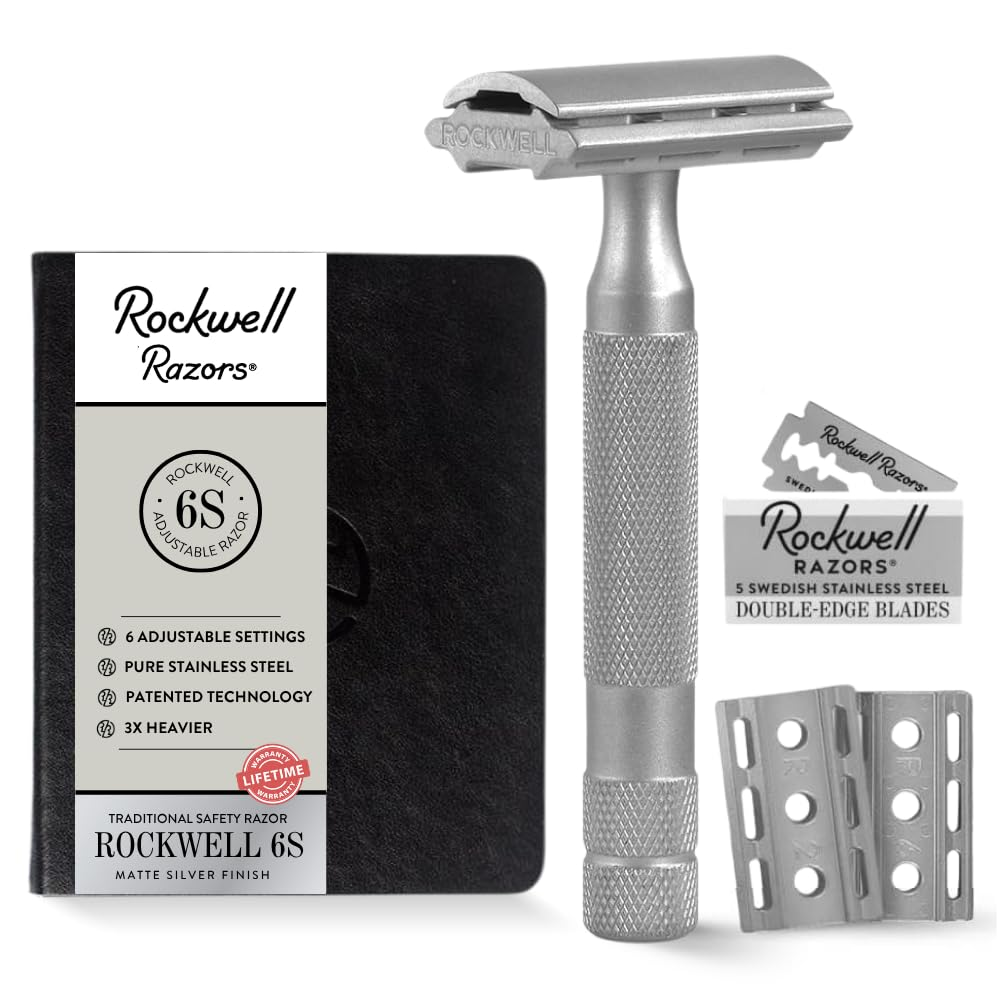
The Rockwell 6S is my top adjustable pick for head shavers because it covers the full aggressiveness range head shaving can call for. Start on plate 2 or 3 during scalp adaptation, move to plate 4 once the skin normalizes and technique is set, and explore plates 5 and 6 as coarse hair demands more efficiency. The full stainless steel build handles the frequent use and thorough rinsing head shaving involves, the 118g weight carries through scalp strokes, and the ability to change settings for different scalp conditions suits anyone with variable sensitivity across days or seasons.
Specifications: 118g, 3.5 inch handle, closed comb on all plates, full stainless steel, adjustable plates 1 through 6.
Pros:
- Covers the full aggressiveness range for every head shaving phase
- Full stainless steel for lifetime durability
- Heavy weight ideal for zero pressure scalp technique
- Dial up as scalp skin adapts and technique improves
- Works well across all standard DE blades
Cons:
- Heavy at 118g, which some find tiring in longer sessions
- Handle at 3.5 inches on the shorter side for scalp reach
- Plate system adds organizational effort
- Higher upfront cost than beginner specific options
Check Rockwell 6S Price on Amazon
5. Merkur 37C Slant: Best for Coarse Scalp Hair
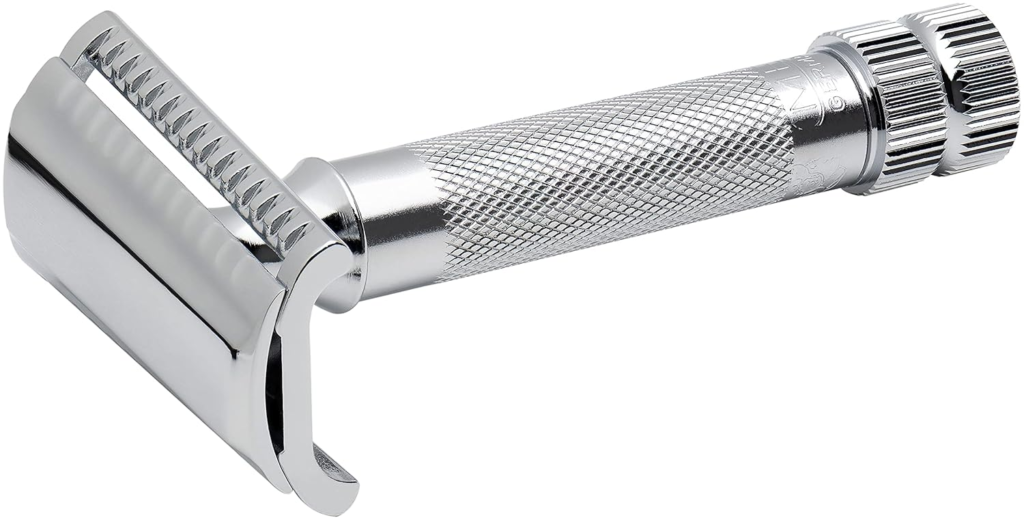
The Merkur 37C Slant is my pick for head shavers with especially coarse or dense scalp hair. Its slant bar orients the blade at an angle to the direction of travel, creating a slicing action, like how a guillotine cuts more efficiently than a straight drop, that cuts through wiry scalp hair better than any straight bar razor with an equivalent gap. It is not a beginner razor though, since the slant needs some technique adjustment and its efficiency can be aggressive on errors, so it suits head shavers with at least two to three months of experience who find mild or medium straight bar razors struggling with their hair.
Specifications: 90g, 3.5 inch handle, slant closed comb, chrome plated zinc alloy, medium with slant action.
Pros:
- Slant action cuts coarse scalp hair more efficiently than straight bar designs
- Medium efficiency without an extreme blade gap
- Less skin trauma than a straight aggressive razor at equivalent efficiency
- Popular with head shavers who have dense or wiry hair
- Good weight for zero pressure technique
Cons:
- Requires technique adjustment beyond standard shaving
- Not suitable for complete beginners
- Handle at 3.5 inches limits reach in some positions
- Chrome plated zinc rather than stainless steel
Check Merkur 37C Price on Amazon
6. Feather AS-D2: Best Premium for Head Shaving
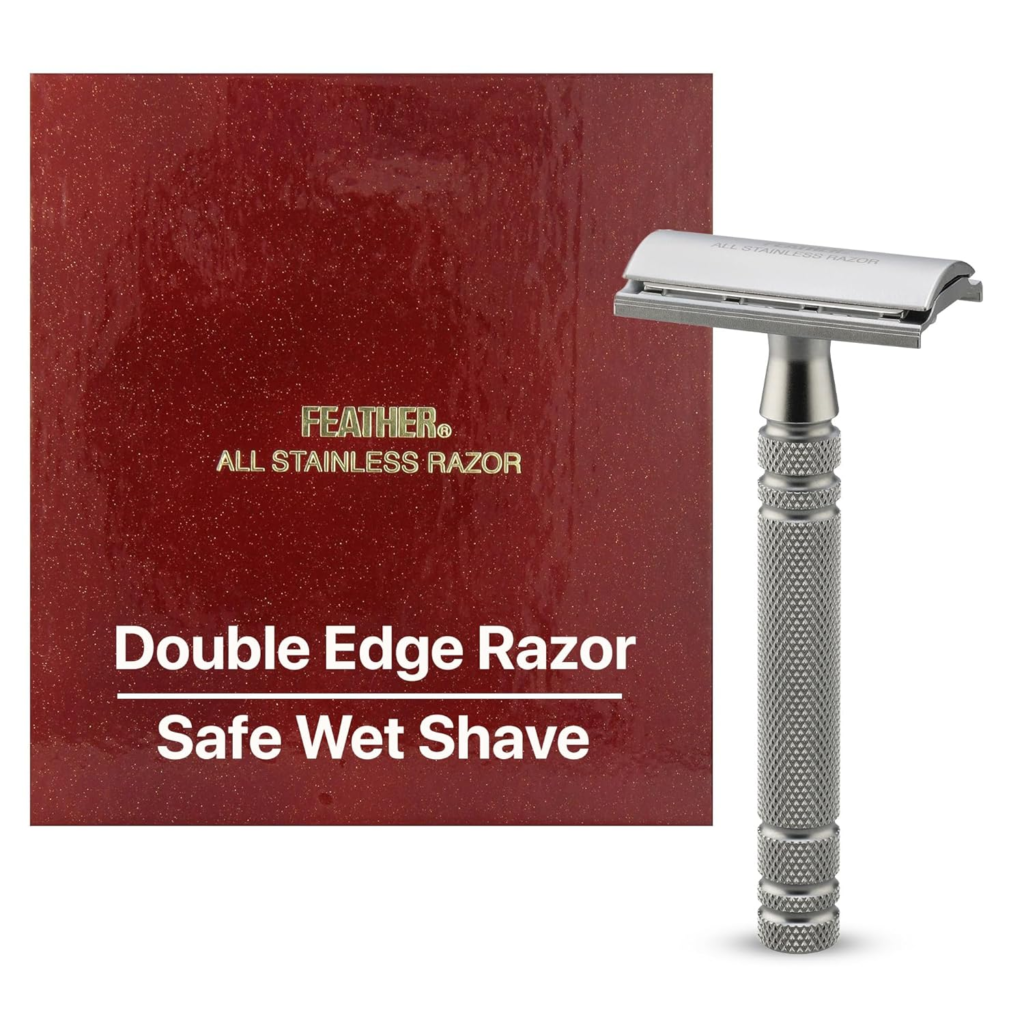
The Feather AS-D2 is my premium pick for experienced head shavers who want the best possible daily shave. Its precision engineering gives a consistent, smooth result experienced head shavers treat as the benchmark, and the full stainless steel build handles daily head shaving indefinitely. At mild to medium aggressiveness it is slightly less efficient on very coarse scalp hair than the Game Changer 0.84 or the Rockwell 6S on higher plates, so for head shavers with medium coarse hair who value consistency and smoothness over maximum efficiency, it remains the finest daily head shaving razor available.
Specifications: 89g, 3.9 inch handle, closed comb, full stainless steel, mild to medium.
Pros:
- Japanese precision engineering for exceptional consistency
- Full stainless steel for indefinite durability
- Smooth and reliable on daily head shaving
- Excellent for scalp skin that has fully adapted
- Pairs beautifully with Feather blades
Cons:
- Very high price
- Mild to medium may struggle with very coarse scalp hair
- Fixed geometry with no adjustability
- May feel underwhelming for those who need more aggressiveness
Check Feather AS-D2 Price on Amazon
7. Parker 99R: Best Budget for Head Shaving
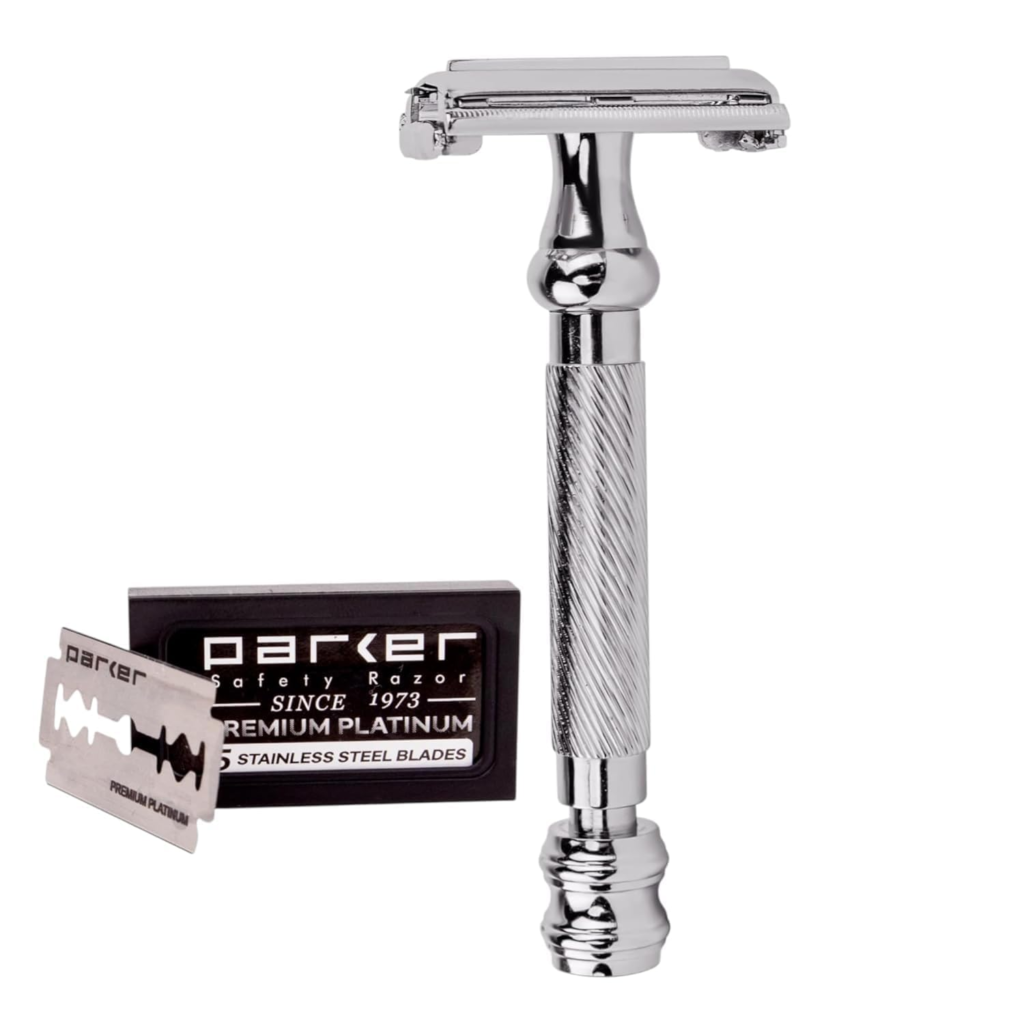
At under $20, the Parker 99R is the best budget entry into safety razor head shaving. The 4 inch handle gives adequate scalp reach, the butterfly opening makes the frequent blade changes head shaving needs simple, and the mild geometry gives developing technique room to make mistakes without serious consequences. Build quality is its main limitation next to Merkur or premium options, and blade alignment precision is slightly less consistent, but for a budget conscious beginner it is a meaningful introduction to safety razor head shaving.
Specifications: 95g, 4.0 inch handle, closed comb, chrome plated brass, mild.
Pros:
- Best budget option for head shaving beginners
- Long handle for comfortable scalp reach
- Butterfly opening simplifies frequent blade changes
- Good weight for zero pressure technique
- Low financial risk for a first head shaving razor
Cons:
- Build quality below Merkur and premium options
- Blade alignment slightly less precise
- Butterfly mechanism loosens with heavy use over time
- Mild geometry may struggle with very coarse scalp hair
Check Parker 99R Price on Amazon
Best Blades for Head Shaving
Blade choice for head shaving skews sharper than for the face because scalp hair is coarser and denser.
| Blade | Sharpness | Smoothness | Head Shaving Rating | Notes |
| Feather New Hi-Stainless | Very Sharp | Smooth | Excellent | For experienced head shavers only |
| Polsilver Super Iridium | Sharp | Very Smooth | Excellent | Best all round for head shaving |
| Astra Superior Platinum | Sharp | Very Smooth | Very Good | Best value for head shaving |
| Gillette Silver Blue | Medium-Sharp | Very Smooth | Very Good | Smooth on scalp skin |
| BIC Chrome Platinum | Medium-Sharp | Smooth | Good | Budget head shaving option |
| Shark Super Stainless | Medium-Sharp | Smooth | Good | Budget alternative |
| Derby Extra | Medium | Smooth | Adequate | Too mild for coarse scalp hair |
Change blades every two to four shaves for head shaving, since coarse, dense scalp hair dulls blades faster than facial hair, so a blade that feels fine for the face may already be too dull for a comfortable head shave at the same count.
Shop Safety Razor Blades for Head Shaving on Amazon
Step by Step: How to Shave Your Head with a Safety Razor
Step 1: Prepare the Scalp Thoroughly
Scalp prep matters more than most beginners realize, since the skin is thicker than facial skin but less adapted to the razor, and thorough warm water prep softens coarse scalp hair and opens the pores so the blade engages more cleanly. Shave right after a warm shower whenever you can, since the warmth, steam and softening are the most effective prep available or hold a warm wet towel on the scalp for three to five minutes, which helps even more than on the face because scalp hair is coarser. A little pre shave oil on the damp scalp before lathering adds lubrication that helps as the razor navigates the curves.
Step 2: Build Your Lather
Apply cream or soap across the whole scalp with a brush or your hands, using circular motions to work it into the dense hair and reach the skin. Use more lather than you think you need, since the scalp is larger than the face and the hair thins the lather faster and many head shavers lather in sections as they go so it does not dry on areas still waiting.
Step 3: Set Up Your Mirrors
Before the first stroke, set up a large mirror in front and a handheld mirror behind, positioned so the back of your head reflects into the front mirror. Some head shavers use adjacent wall mirrors instead and either way, test the setup before lathering so you are not adjusting mirrors with a lathered scalp.
Step 4: Begin at the Front and Top
Start at the front hairline and work back toward the crown, the area with the most consistent geometry and best visibility, using smooth two to three inch strokes in overlapping rows. Keep the roughly 30 degree angle to the skin, noticing that the handle tilts to different angles relative to the floor as the surface curves, which is normal since your reference is the skin, not the floor. Rinse the blade every two to three strokes, since head shaving clogs blades faster than face shaving and a clogged blade drags.
Step 5: Shave the Sides
The sides are more accessible with better visibility, so work from the temple down toward the ear and neck hairline with shorter strokes on the curve near the ear. Fold the ear forward gently with your free hand to reach behind it, use very short one to two inch strokes there and stay aware of where the edge is relative to the ear cartilage.
Step 6: Navigate the Crown
The crown is the most challenging area because of its pronounced curve and the way hair often radiates outward from a central point, so the grain changes continuously around it. Feel the grain with a finger in different directions first, shave the smooth direction on the first pass and use short one to two inch strokes so you can recalibrate the angle between each one.
Step 7: Shave the Back of the Scalp
The back is where technique is most tested, since mirror visibility is limited and most shavers work by feel. Start at the crown and work down to the nape with short, careful strokes, keeping your free hand on the scalp just ahead of the razor to feel for missed patches. The nape has loose skin that folds easily, so stretch it taut with your free hand before each stroke, since loose skin folds in the blade gap are the most common cause of nicks there.
Step 8: First Pass Assessment
After the first with the grain pass, rinse with cool water and run your hands over the scalp, where you should feel a big reduction in length and smoothness in the grain direction. Find and fix any missed areas before re-lathering, check for nicks or irritation and adjust your angle or pressure before the second pass.
Step 9: Second Pass Across or Against the Grain
Re-lather the whole scalp for the second pass, since a second pass across the grain, perpendicular to the first pass on each area, improves closeness significantly. An against the grain pass is more demanding on the scalp than the face because of the continuous curvature, so add it only once your two pass technique is consistently comfortable and the skin has fully adapted and for many head shavers two passes is smoother than anything clippers or cartridges achieved.
Step 10: Post-Shave Scalp Care
Rinse the scalp with cool water after the final pass, then apply an aftershave balm or scalp moisturizer while the skin is still slightly damp, since the scalp absorbs more than facial skin and lacks the sebum protection facial skin builds over years of shaving. Aloe vera gel is a popular choice that soothes without clogging pores and sun protection matters for a freshly shaved head, so an SPF moisturizer is a worthwhile habit before outdoor exposure.
Shop Head Shaving Post-Care Products on Amazon
Managing the Difficult Areas
Behind the ears, the loose skin folds against the head, so pull the ear forward gently and use extremely short strokes, since this is a common nick spot for beginners that slowing down almost entirely prevents. At the nape of the neck, where head hair meets neck hair, the boundary is irregular, the skin is loose and the angle changes fast, so short strokes with stretched skin and a mirror positioned on the area give the best result. At the crown, take more time than on the flat top with short strokes and frequent angle adjustment, since rushing it is the most reliable way to produce an inconsistent shave and never shave directly over any existing bump, cyst or irritation, since navigating around it is how you avoid turning a minor blemish into a real cut.
Building a Head Shaving Routine
Most head shavers shave every one to three days, since daily shaving keeps scalp hair at a length that responds well to a safety razor while less frequent shaving increases blade load and passes per session. Morning shaving gives a fresh look through the day, while night shaving lets any minor redness settle overnight and avoids rushing a busy morning and both work well.
The first month is the scalp adaptation phase, when the skin is more reactive than it will become, so use a mild razor, change blades often, limit yourself to one or two passes and moisturize afterward, and do not judge head shaving by the first month alone, since developing technique and adapting skin both improve steadily. After three to six months most shavers have a routine that gives consistent, excellent results, at which point exploring a razor upgrade or a step up in aggressiveness from the beginner baseline is worth considering.
Amazon Affiliate Disclaimer
This post contains affiliate links. If you buy through one of them, we may earn a small commission at no extra cost to you.
Frequently Asked Questions
What is the best safety razor for head shaving?
For beginners, the mild, long handled Merkur 23C is the best starting point. The heavy Merkur 38C is the top choice if you prefer a weighty razor, the Rockwell 6S is the best adjustable option and the Merkur 37C Slant is best for coarse scalp hair. All work well for shaving your head with a safety razor.
Is head shaving with a safety razor difficult to learn?
The learning curve is longer than for the face because of the scalp’s curved shape and the limited visibility of the back of the head. Most men develop comfortable, consistent technique within three to six weeks and daily shaving during the learning phase speeds it up.
Does shaving your head with a safety razor cause irritation?
Some scalp irritation is normal in the first two to four weeks as the skin adapts to regular razor contact. A mild razor, frequent blade changes and thorough pre and post shave care minimize it and most of it resolves as technique develops and the skin adapts.
How often should I shave my head with a safety razor?
Every one to three days is typical. Daily shaving keeps growth at a level that responds easily to a safety razor, while less frequent shaving increases the demand on blade and technique per session.
What is the best blade for head shaving?
Polsilver Super Iridium and Astra Superior Platinum are the top all round picks, both sharp enough for coarse scalp hair yet smooth on scalp skin. Feather blades are excellent for experienced head shavers with established technique.
Can I use any safety razor to shave my head?
Most mild to medium safety razors work but a longer handle helps with scalp reach, and a mild to medium or adjustable razor suits coarse scalp hair better than an ultra mild option. The picks in this guide are the best options for each experience level.
How do I shave the back of my head without cutting myself?
Use short strokes, a second mirror, stretched skin at the nape, and frequent rinsing. Feel based technique develops with practice, so most experienced head shavers navigate the back reliably without constant mirror reference and the early phase benefits from the most complete mirror setup you can arrange.
Should I moisturize after head shaving?
Yes, always. The scalp absorbs post shave products more readily than facial skin, so regular moisturizing keeps the skin healthy with regular shaving and a fragrance free balm or aloe vera gel is the safest choice, especially during adaptation.
Is sun protection necessary after head shaving?
Yes. A freshly shaved scalp has no hair to protect it from UV, so if you will be outdoors, apply an SPF moisturizer to the scalp, since sunburn on a freshly shaved head is both more likely and more uncomfortable than on unshaved skin.