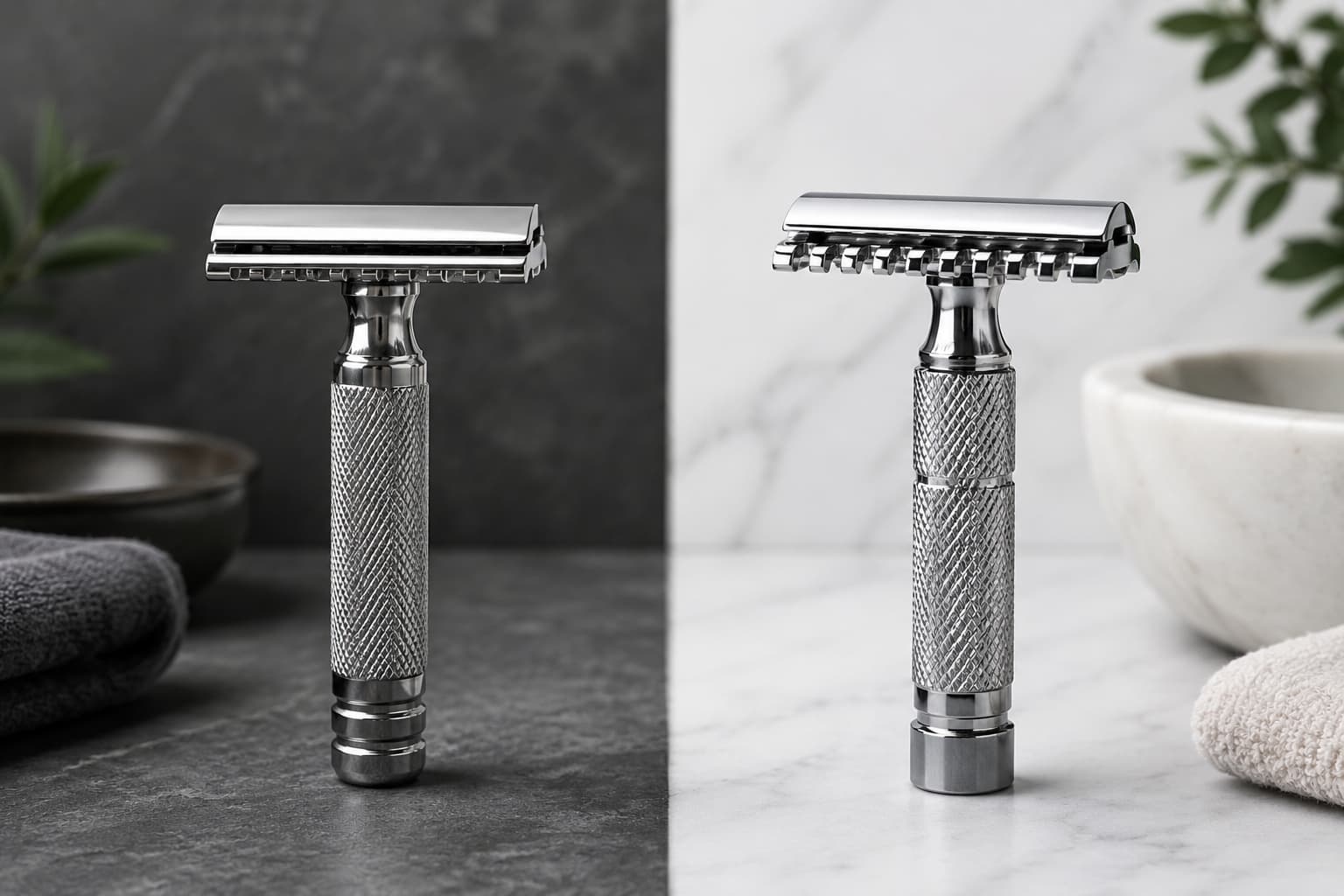
Pick up two safety razors that look nearly identical from a distance and the difference that separates them may be invisible until you flip the razor over and look at the underside of the head. One has a solid bar running beneath the blade and the other has a row of teeth. That structural difference, less than a centimeter of metal, fundamentally changes the shave in ways that matter for every serious wet shaver.
The closed comb versus open comb distinction is one of the most important and least understood ideas in safety razor selection. It gets mentioned in buying guides, debated in forums and referenced in razor descriptions without always being explained clearly and many shavers use their razors for years without knowing which type they have or how that design affects their shave. This guide covers every meaningful part of the comparison: the mechanics of each design, who benefits from each, the best examples of both, how to choose and whether the choice matters as much as some discussions suggest.
What Is a Closed Comb Safety Razor? (Quick Answer)
A closed comb safety razor, sometimes called a safety bar razor, has a solid, continuous bar of metal running beneath the blade edge, with no teeth or gaps. That solid bar stretches the skin evenly and protects it consistently along the whole length of the blade, which makes the closed comb the more forgiving, more predictable and more beginner friendly design. It is the most common type of safety razor sold today, and for the vast majority of shavers it is the right choice. An open comb, by contrast, replaces that solid bar with a row of teeth, which is the entire difference between the two. The rest of this guide explains what that difference means in practice.
Quick Reference: Closed Comb vs Open Comb at a Glance
| Factor | Closed Comb | Open Comb |
| Safety Bar Design | Solid continuous bar | Toothed or scalloped bar |
| Aggressiveness | Generally milder | Generally more aggressive |
| Skin Stretching | More consistent | Less consistent |
| Lather Management | Contains and controls | Channels through teeth |
| Best For Dense Hair | Less efficient | More efficient |
| Best For Long Growth | Less efficient | More efficient |
| Forgiveness | Higher | Lower |
| Beginner Suitability | High | Low to moderate |
| Blade Exposure | Lower to moderate | Moderate to high |
| Irritation Risk | Lower | Higher without technique |
| Classic Examples | Merkur 34C, Edwin Jagger DE89 | Mühle R41, iKon 101 |
Understanding the Safety Bar: What It Does
Before separating closed comb from open comb, it helps to understand what the safety bar does. Both designs include a safety bar in the broad sense, a structural element beneath the blade that protects the skin from full blade contact and the difference is in the form that element takes.
The safety bar does three things during a shave. It stretches the skin ahead of the blade, creating a taut, even surface for the blade to travel across. It limits how much blade contacts the skin in any stroke, which is the protective element that defines the whole safety razor category. It manages lather, removing the cream and debris the blade clears and directing it away from the cutting path. How effectively and in what way the bar performs these three functions differs significantly between the two designs.
What Is a Closed Comb Safety Razor?
A closed comb safety razor has a solid, continuous bar of metal running directly beneath the blade edge, so looking at the head from the front you see the blade above and a smooth, unbroken bar below, with no gaps, teeth or interruptions.
The closed comb stretches the skin continuously as the razor travels across the face, since every point along the blade’s path has the same skin stretching geometry from the uniform solid bar and the blade contacts the skin through a consistent, protected relationship with the bar at every point. That consistency is the closed comb’s main advantage: the shave geometry, skin protection, and lather clearance are all uniform and predictable behavior across the whole stroke makes it the more forgiving, more consistent design for most shavers.
The solid bar also contains lather more effectively during a stroke, since the cream and hair debris accumulate between blade and bar rather than channeling through gaps, so the blade needs rinsing slightly more often on very heavy growth, though for normal daily or every other day shaving that is not a practical limitation.
Check Closed Comb Safety Razor Prices on Amazon
Who Benefits Most from Closed Comb
Beginners without established technique benefit most, since the consistent, forgiving geometry creates the widest margin for technique errors, so a beginner on a mild closed comb can make small mistakes per stroke without significant consequence. Shavers with fine to medium beard growth benefit too, since closed combs handle that hair efficiently without the extra channeling dense hair needs. Shavers with sensitive skin do well, since the continuous bar stretches skin consistently and gently. Daily shavers dealing with short growth are well suited, since the tight, consistent geometry works best on short hair and shavers who value consistency over maximum efficiency prefer it, since the predictable behavior makes it the daily driver many experienced shavers keep.
What Is an Open Comb Safety Razor?
An open comb safety razor has a toothed or scalloped bar beneath the blade rather than a solid one, with channels between the teeth that let lather, hair and debris pass through the head during a stroke rather than accumulating between blade and bar. From the front, an open comb shows a row of teeth pointing away from the blade with gaps between them.
The open comb was actually more common than the closed comb in the earliest years of safety razor production, and many early Gillette razors used it before the closed comb became dominant through the mid twentieth century. It never disappeared and it has had a revival in the modern wet shaving community as knowledge of its specific advantages has spread.
Check Open Comb Safety Razor Prices on Amazon
How the Open Comb Changes the Shave
The teeth do several things at once. They comb through the beard hair as the razor travels, standing it up slightly before the blade contacts it. They create channels through which thicker lather and longer hair can flow without clogging the blade gap. And they create a slightly more direct blade to skin contact path, since the teeth do not provide the continuous skin stretching a solid bar does. That more direct path is what makes open comb razors generally more aggressive than closed comb razors with equivalent blade gaps, giving more efficient cutting per stroke but less forgiveness when technique is imprecise.
The Lather Management Advantage
The most practical and immediately noticeable advantage of an open comb is lather management. On very dense beard hair, a closed comb can become overwhelmed during longer strokes, with lather and debris building between blade and bar until cutting efficiency drops, whereas the open comb channels that debris through the teeth and keeps efficiency up through longer strokes on dense hair. For shavers who shave daily and keep growth short, this advantage is minimal since the volume per stroke is low regardless of comb type, but for shavers who go every two to three days or have particularly dense growth, it becomes a genuine benefit.
Who Benefits Most from Open Comb
Shavers with dense, thick, or coarse beard hair benefit most, since the channeling capacity handles high volume hair efficiently. Shavers who shave less frequently benefit, since two or three days of growth needs more channeling than daily growth. Experienced shavers with solid technique who want more efficiency benefit, since the higher aggressiveness rewards confident, consistent angle and pressure. Shavers who have already maximized their closed comb results and want to explore the efficiency ceiling of the format find the open comb the next step.
Aggressiveness: Is Open Comb Always More Aggressive?
This is one of the most common oversimplifications in the debate and it deserves a nuanced answer.
In general, open comb razors tend to be more aggressive than closed comb razors from the same manufacturer with all else equal, so the Mühle R41 open comb is significantly more aggressive than the Mühle R89 closed comb and the iKon 101 open comb is more aggressive than most closed comb alternatives. That relationship holds broadly but all else is not always equal, since blade gap, blade exposure and head geometry vary independently between razors, so a mild open comb with a small gap and conservative exposure can be less aggressive than an aggressive closed comb with a large gap and positive exposure. The vintage Gillette NEW Long Comb, an open comb with a modest gap, is less aggressive than the closed comb RazoRock Game Changer 1.05 with its large gap. So comb type is one factor in aggressiveness, not the only one and when comparing specific razors the full geometry of gap, exposure and comb type together determines aggressiveness rather than comb type alone. Understanding aggressiveness means looking at the complete head geometry rather than any single element, as our guide to aggressive vs mild safety razors explains.
The Skin Stretching Difference
The skin stretching function produces one of the most tactilely noticeable differences between the two.
A closed comb stretches the skin consistently along its entire length, so every point of skin ahead of the blade receives identical stretching from the solid bar, creating a flat, taut, even surface that is highly predictable. For sensitive skin, this consistent stretching is beneficial because it creates favorable conditions for a low trauma pass, since the blade always meets skin prepared the same way by the bar in front of it.
An open comb stretches the skin only where the teeth contact it, so between the teeth the skin is not stretched the same way, and the blade meets slight variation in skin condition across its length. For most shavers this variation is imperceptible in practice, since the teeth are close enough together that the functional difference between tooth and gap positions is minimal, but for very sensitive or reactive skin the slightly less consistent stretching can contribute to small irritation differences compared with the same blade gap in a closed comb.
Lather Retention: A Practical Consideration
The lather retention difference matters more for some shavers than others. For daily shavers with fine to medium growth and good lather technique, closed comb lather retention is essentially a non issue, since each stroke removes a manageable volume the solid bar channels away adequately. For shavers with dense beards going every two to three days, the open comb’s channeling becomes a practical advantage, since heavy growth can begin to clog a closed comb’s blade gap during longer strokes and need more frequent rinsing, while the open comb channels the volume through the teeth for longer, more efficient strokes. For men who grow a beard out and then shave it off periodically rather than maintaining regular shaving, an open comb is the more practical tool for that longer initial shave.
Best Closed Comb Safety Razors
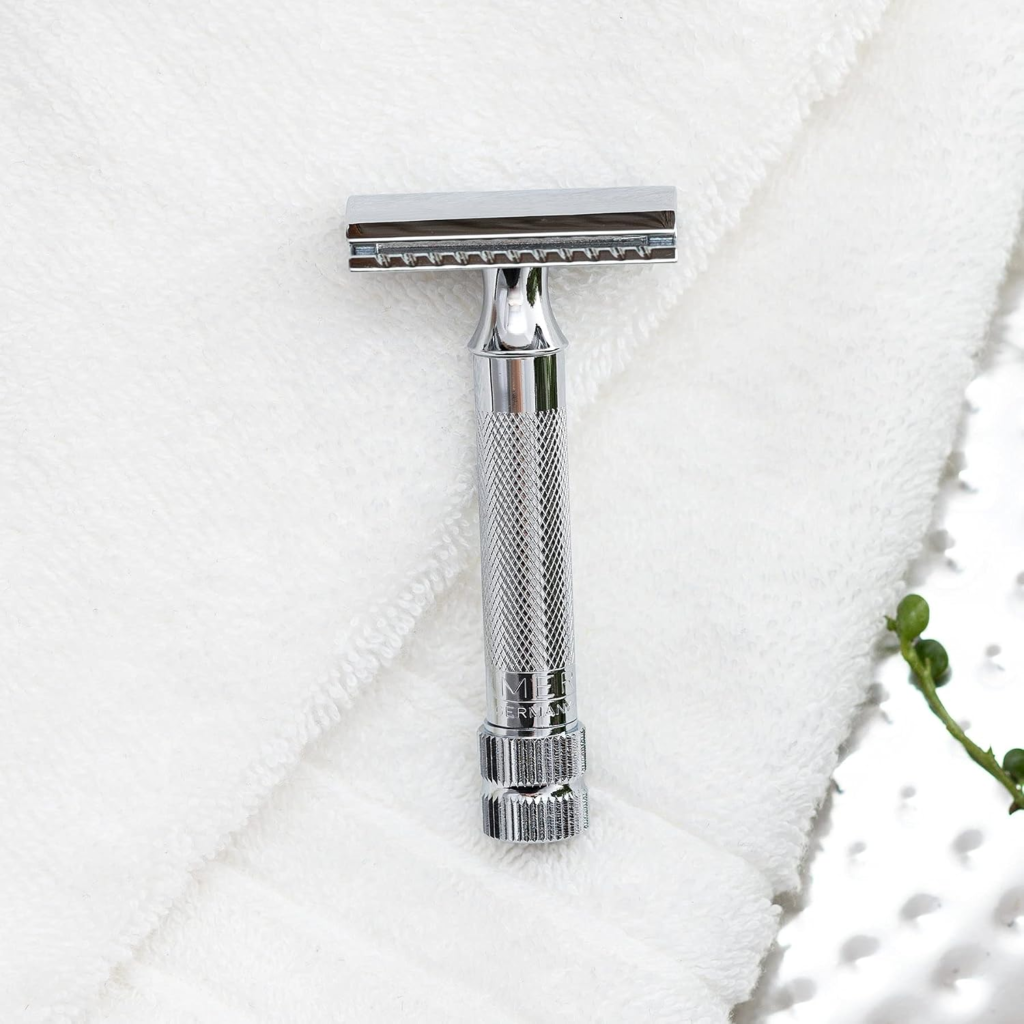
The Merkur 34C is the benchmark beginner to intermediate closed comb razor, mild, well built and consistent, and it is the starting recommendation in our best safety razors of 2026 guide.
Check Merkur 34C Price on Amazon
The Edwin Jagger DE89 is British made, mild, excellent for sensitive skin, and widely available, one of the most recommended everyday closed comb razors globally, covered in our best safety razors for sensitive skin guide.
Check Edwin Jagger DE89 Price on Amazon
The Rockwell 6S is a full stainless steel adjustable with all closed comb plates, offering six aggressiveness settings within the closed comb format, the most versatile closed comb option available, covered in our best premium safety razors guide.
Check Rockwell 6S Price on Amazon
The RazoRock Game Changer 0.84 is a mid range stainless head closed comb that hits the mild to medium sweet spot for intermediate shavers with medium beards, and one of the most recommended step ups from mild beginner razors.
Check RazoRock Game Changer Price on Amazon
The Feather AS-D2 is a premium Japanese precision closed comb that delivers the finest daily shave consistency available in the format.
Check Feather AS-D2 Price on Amazon
The Mühle R89 is a German engineered mild closed comb at a mid range price, with the same head geometry as the Edwin Jagger DE89 and different handle options.
Check Mühle R89 Price on Amazon
Best Open Comb Safety Razors
The Mühle R41 is the most widely cited aggressive open comb from a mainstream maker, very efficient on coarse and dense hair and for experienced shavers only.
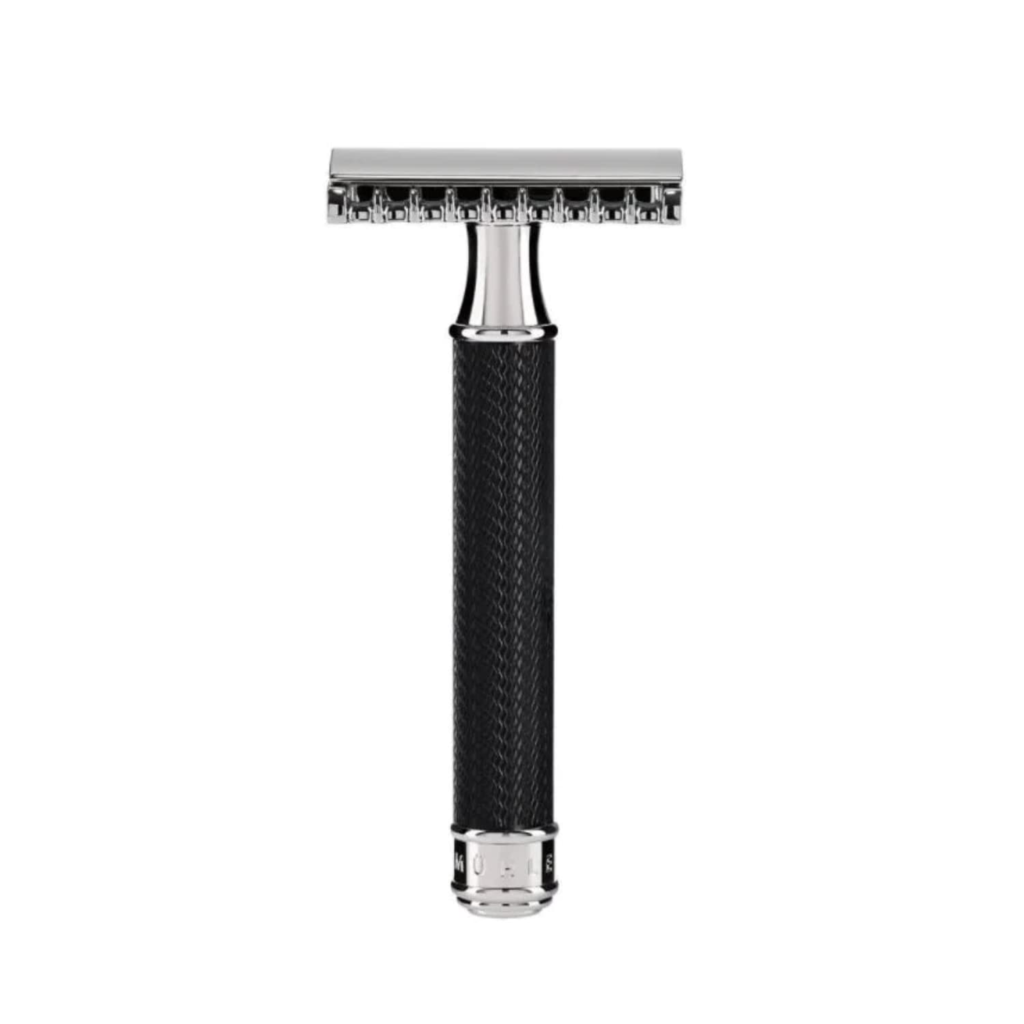
Check Mühle R41 Price on Amazon
The Karve Christopher Bradley open comb plates bring the precision machining of the Christopher Bradley platform to the open comb format, available in B through F configurations, the best combination of open comb efficiency and precision engineering available.
Check Karve Christopher Bradley Price on Amazon
The iKon 101 is a USA made precision open comb in stainless steel, popular in experienced shaver communities for its efficient, precise shave, with a medium to aggressive character suited to experienced shavers with medium to coarse beards.
Check iKon 101 Price on Amazon
The Merkur 25C is a mild to medium open comb that occupies a useful middle ground between ultra mild closed combs and the more aggressive open combs from Mühle and iKon, ideal for exploring open comb shaving at a less aggressive starting point.
Check Merkur 25C Price on Amazon
The Gillette NEW Long Comb is a vintage 1930s open comb that shaves with remarkable effectiveness despite its age, available on the secondary market at accessible prices and a popular entry point into vintage open comb shaving for collectors.
The RazoRock Hawk V3 is a single edge open comb that offers an alternative take on the format through the Artist Club blade system, popular in the single edge community as an open comb option.
Pros and Cons Summary
Closed comb pros: more forgiving of technique errors, consistent skin stretching across the full blade length, better suited for sensitive skin, more appropriate for fine to medium growth, a wide range from ultra mild to aggressive, and the dominant format in the modern market. Closed comb cons: less efficient on very dense or long growth, can become less effective on heavy growth without frequent rinsing, a lower ceiling on cutting efficiency than the best open combs, and less authentic to the earliest safety razor tradition.
Open comb pros: more efficient on dense and coarse hair, better lather management on heavy growth, a higher cutting efficiency ceiling, a traditional design with a long pedigree and preference among many experienced shavers for specific beard types. Open comb cons: less forgiving of technique errors, not recommended for beginners, can be harsher on sensitive skin, a more aggressive range that makes wrong razor selection more consequential and fewer mild options than closed comb.
Does the Comb Type Actually Matter for Most Shavers?
This is the honest question many guides dance around, so here is the direct answer.
For most daily shavers, closed comb is fine. The vast majority of people who shave regularly with fine to medium growth at a daily or near daily frequency will never hit a practical limitation of the closed comb format and the closed comb razors here deliver excellent results across the full range of needs most people have, so the open comb is worth exploring as an enthusiast option once closed comb shaving is well established, not as a necessary upgrade.
For dense beard shavers, open comb deserves consideration. Shavers with particularly dense, coarse or thick beards who go every two to three days rather than daily will find the efficiency and lather management of a quality open comb genuinely meaningful, with the Merkur 25C as the accessible starting point and the Mühle R41 or iKon 101 for those with established technique who want maximum efficiency.
For beginners, closed comb always comes first. No beginner should start with an open comb, since the combination of higher aggressiveness and reduced forgiveness produces more nicks, more irritation and more chance of abandoning safety razor shaving before technique develops, so a mild closed comb is the universal starting recommendation and our guide on how to shave with a safety razor covers technique development in full.
How to Choose Between Closed Comb and Open Comb
Choose a closed comb if you are new to safety razor shaving, if you have fine to medium beard hair you shave daily or every other day, if you have sensitive or reactive skin, if you value consistency and predictability over maximum efficiency or if you have not yet maxed out the performance of a quality closed comb.
Explore an open comb if you have dense, thick, or coarse beard hair a closed comb struggles to handle efficiently, if you shave every two to three days and find lather management becomes an issue with heavy growth, if you are an experienced shaver who wants to explore the efficiency ceiling or if you have a specific interest in vintage designs that happen to be open comb.
Try a mild open comb first if you are curious but cautious about the aggressiveness jump, since the Merkur 25C or a vintage Gillette NEW Long Comb are accessible entry points that allow open comb exploration without committing to a fully aggressive razor.
Amazon Affiliate Disclaimer
This post contains affiliate links. If you buy through one of them, we may earn a small commission at no extra cost to you.
Frequently Asked Questions
What is the difference between an open comb and closed comb safety razor?
A closed comb has a solid, continuous bar beneath the blade, while an open comb has a toothed or scalloped bar with channels between the teeth. The closed comb gives consistent skin stretching and protection, while the open comb channels lather and hair more efficiently through the teeth, which suits dense hair and heavy growth at the cost of being less forgiving.
What is a closed comb safety razor?
It is a safety razor with a solid, continuous bar of metal beneath the blade, with no teeth or gaps. The bar stretches the skin evenly and protects it consistently, which makes the closed comb the most forgiving and beginner friendly design and the most common type of safety razor sold today.
Are open comb razors more aggressive than closed comb razors?
Generally yes with all else equal, since the teeth provide less consistent skin protection than a solid bar, usually giving more blade to skin contact per stroke but blade gap and exposure also matter a lot, so a mild open comb with a small gap can be less aggressive than an aggressive closed comb with a large gap.
Should a beginner use an open comb or closed comb razor?
Always a closed comb. The consistent, forgiving geometry of a mild closed comb is the safest and most effective learning environment for new technique and open combs should wait until technique is well established.
Is an open comb better for coarse hair?
Generally yes, since the channeling capacity handles coarse, dense or long growth more efficiently, and many coarse bearded shavers find open combs need fewer passes for comparable closeness. That said, a slant closed comb like the Merkur 37C can also handle coarse hair very effectively through a different mechanism.
Can I use an open comb razor on sensitive skin?
With the right technique and a mild open comb, yes, but most sensitive skin shavers find closed combs more comfortable because the consistent skin stretching of the solid bar creates more favorable conditions for a low trauma shave. Open combs on sensitive skin need particularly precise technique.
What is the best open comb razor for beginners?
The Merkur 25C is the most accessible option for exploring the format at a lower aggressiveness than the Mühle R41 or iKon 101, and a vintage Gillette NEW Long Comb is another accessible entry point, though neither is recommended for complete beginners who have not yet established solid technique.
Do I need both a closed comb and an open comb razor? Most shavers do not. A quality adjustable closed comb like the Rockwell 6S covers the full aggressiveness range most people ever need, and adding an open comb makes sense mainly for those who specifically need its lather management for dense hair or an infrequent shaving schedule.
What does a closed comb razor feel like compared to an open comb? A closed comb feels smoother and more cushioned, with the solid bar creating a consistent gliding sensation as it stretches the skin evenly ahead of the blade, while an open comb feels more direct and immediate, with the teeth perceptible in a way a solid bar is not and the blade engagement feeling less mediated. Neither is objectively better, they are different experiences that suit different shavers.