Switching to a safety razor for your legs is one of those decisions most women describe the same way afterward, they wish they had done it sooner. The mix of a closer shave, far lower ongoing cost, less irritation and much less plastic waste makes a safety razor the better tool for leg shaving in almost every measurable way.
The adjustment period is real, since shaving your legs with a safety razor is not the same as dragging a five blade cartridge across a flat shin without thinking. There is a technique to learn, a rhythm to find and a few areas like the knee, the ankle and the back of the calf that need specific attention until it becomes second nature but the adjustment is short and most women feel genuinely comfortable and confident within two to three weeks of regular practice. This guide covers everything from preparation to aftercare, including which safety razor for legs suits you best, so you can make the switch with confidence.
Why Safety Razors Are Better for Leg Shaving
Before the technique, it helps to understand exactly why a safety razor outperforms a cartridge on legs because the reasons are more specific than most people realize.
The Single Blade Advantage
Multi blade cartridges work by hysteresis, where the first blade lifts each hair and the following blades cut it progressively shorter, with the last one cutting below the skin surface. On the face this causes razor bumps and ingrown hairs and on the legs it does the same, especially where hair is coarser or skin is thinner, like the knee, inner thigh, and bikini line. A single blade safety razor cuts at skin level without that lifting and subsurface cutting cycle, so the hair is severed cleanly at the surface and grows back through it rather than retracting and curling under. The result is fewer ingrown hairs, less bumpiness, and noticeably smoother skin in the hours after shaving.
Better Closeness on Large Surfaces
Legs are large, fairly flat surfaces that suit a sharp single blade very well. A fresh double edge blade glides across the shin with a clean cutting action that leaves smoother results in fewer strokes than a worn multi blade cartridge and women who switch often report their first safety razor leg shave was smoother than any cartridge shave they had before.
Cost Savings on High-Volume Shaving
Women usually go through blades faster than men, because legs and the bikini area cover far more surface than a man’s face. A cartridge that lasts a week of face shaving dulls much faster on legs and at $3 to $8 per cartridge that adds up quickly. A double edge blade costs 10 to 50 cents, so even changing it every three to four shaves, which is right for legs, the yearly blade cost is a fraction of the cartridge equivalent.
Sustainability
Women’s razor waste is among the highest of any single use plastic category in grooming, thanks to blade volume, plastic cartridges and frequent replacement. A safety razor removes almost all of that, since the razor lasts years and the only ongoing waste is a small metal blade, which makes it one of the most meaningful everyday sustainability switches you can make.
Check the Best Safety Razors for Women’s Leg Shaving on Amazon
Best Safety Razors for Legs: What to Choose
Not every safety razor suits leg shaving equally, so here is what matters most when picking a safety razor for legs, followed by the top recommendations.
Handle Length
Handle length is the single most important factor for legs. A short handle that is perfect for the face becomes awkward when you are reaching down a leg, working behind a knee or around an ankle. Most women find at least 3.5 inches is the minimum comfortable length, and 4 to 4.5 inches is ideal.
Weight
A heavier razor helps on legs, because the weight carries it across the large flat surface without you adding pressure, which is especially useful while you are still building the zero pressure habit. A razor in the 70g to 100g range is ideal.
Aggressiveness
A mild razor is the right choice for most women, since the skin on legs, particularly the inner thigh, behind the knee and around the ankle, benefits from the forgiving geometry of a mild closed comb razor. Once you have several months of practice and want more efficiency on the tougher lower leg and shin, you can try a mild to medium razor but starting mild is always the right call and our guide to the best safety razors for sensitive skin covers the gentlest options.
The Top Safety Razors for Legs
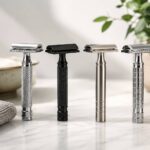
These five are the strongest safety razors for women’s leg shaving and our full guide to the best safety razors for women covers them in more detail.
- Merkur 23C: long handle, mild, trusted quality and the most consistent recommendation for women new to safety razors.
- Hanni Weighted Razor: designed specifically for women’s body shaving, with a weighted handle that encourages correct technique.
- Parker 99R: budget friendly, long handle and a butterfly opening for easy blade changes.
- Hatteker: a beautiful design that is mild and gentle and particularly effective on sensitive skin.
- Leaf Razor: a pivoting head that suits leg curves well and a great transition razor for women coming from cartridges.
What You Need Before You Start
Getting your setup together before the first shave makes the whole thing smoother and safer.
The razor: any mild safety razor with a handle of at least 3.5 inches, from the recommendations above and not an aggressive one to start.
The blades: begin with Astra Superior Platinum or Gillette Silver Blue, both sharp enough for efficient leg coverage yet smooth enough for sensitive areas, and buy a sampler pack for longer term testing. Change blades every three to four leg shaves because of the large surface area.
Shaving cream or gel: quality cream applied with a brush makes the best lather, since the extra lubrication lets the razor glide across the shin and calf rather than drag. If you do not have a brush, a thick gel applied generously beats thin canned foam, and you should apply more than you think you need because large surfaces run through lather fast.
A mirror and good light: many leg shaving accidents happen from poor visibility in a steamy shower, so make sure you can clearly see the area you are shaving.
Post shave products: a lightweight fragrance free moisturizer or aftershave balm helps the skin recover and stay smooth and you should avoid strongly fragranced products on freshly shaved skin, which is more permeable and prone to irritation.
Check Leaf Shave Razor Price on Amazon
Step by Step: How to Shave Your Legs with a Safety Razor
Step 1: Prepare Your Legs
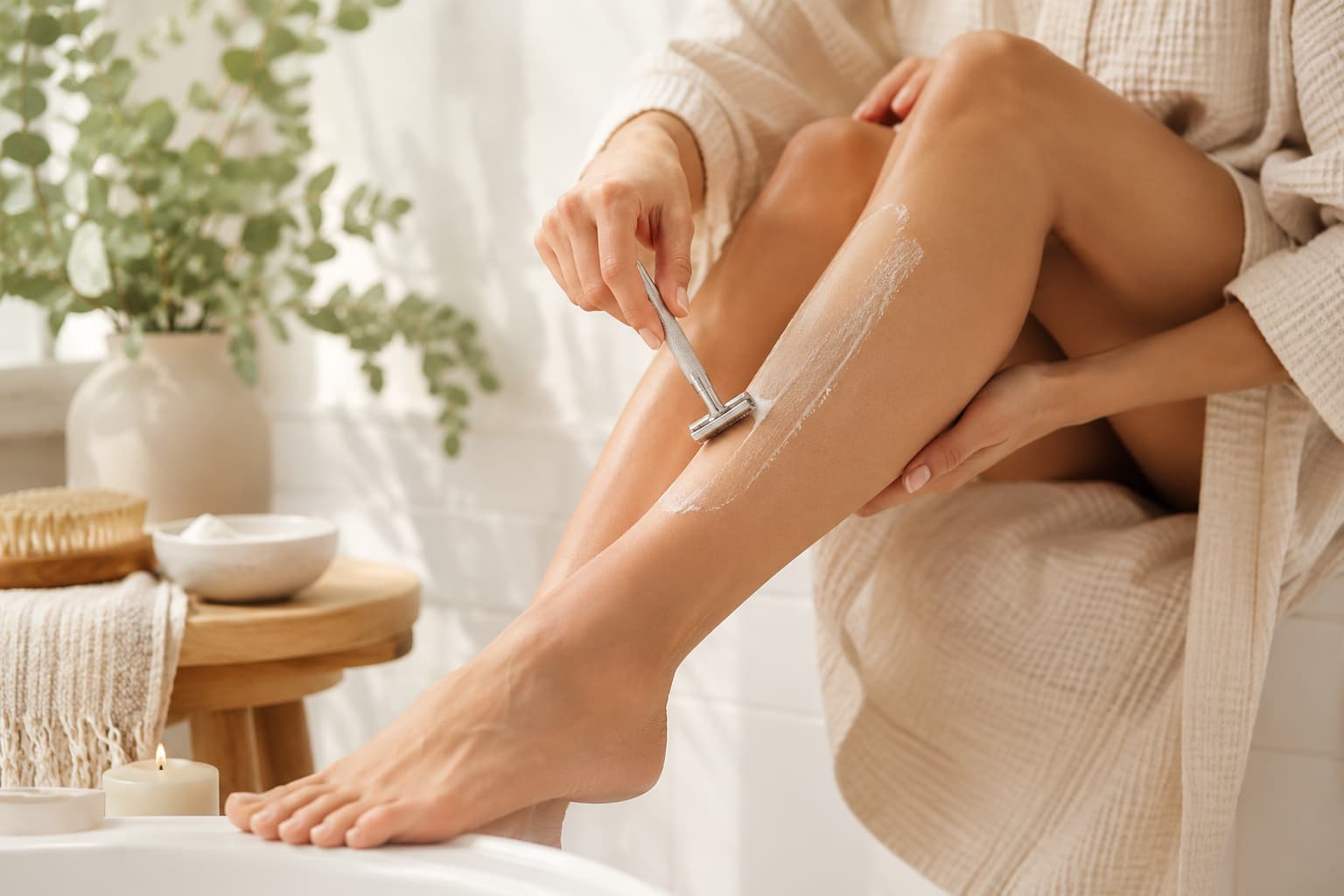
The most important prep is warm water. Shave after a warm shower or after soaking your legs for five to ten minutes, since warm water softens the hair and opens the pores so the blade cuts more cleanly with less resistance, which directly reduces razor burn and irritation. Never shave dry legs, because a dry safety razor leg shave reliably causes irritation, nicks, and a bad first experience. If you use a pre shave oil, work a few drops into damp legs before lathering for an extra glide layer, which helps most on the shin where the skin is thinnest and closest to bone.
Step 2: Apply Shaving Cream Generously
Apply cream or gel generously across the whole area you plan to shave, working a brush in with circular motions to lift the hair, or spreading an even layer by hand that will not dry before you start. Lather one leg at a time rather than both at once, since the second leg’s lather dries before you reach it. Give extra lather to the thinner skinned areas, behind the knee, around the ankle, and the inner thigh, where drying lather causes the most irritation.
Step 3: Find the Correct Angle
Finding the angle is the most important technical step. The same thirty degree principle as face shaving applies, and the curve of the leg makes it a little easier to find. Hold the handle away from the leg at about forty five degrees from horizontal, then tilt the head inward until the blade makes light contact and you feel a slight engagement with the hair, which is the right angle. If the head sits flat with no cutting action the angle is too shallow, and if the blade bites into the skin it is too steep. On flat surfaces like the shin and calf this is easy to hold, while on curves like the back of the knee and the ankle you consciously adjust your wrist as the razor travels, which is the skill that takes the most practice.
Step 4: Shave With the Grain
Start at the ankle and shave upward, which is with the grain for most women since leg hair generally grows downward. Use smooth strokes of three to four inches rather than one long drag from ankle to knee because shorter strokes give better control and let you rinse more often. Rinse the blade every three to four strokes, since a blade loaded with hair and cream drags instead of cutting. Use your free hand to lightly stretch the skin ahead of the razor on curves and loose areas, which flattens the surface and stops the blade catching a fold. Work methodically through the lower leg, then the knee, then the upper leg, to avoid double passes and missed patches.
Step 5: Navigate the Knee Carefully
The knee is the most technically challenging area, with its curved kneecap, loose folded skin at the back, and constantly changing angle. For the front, bend your knee slightly and shave in short strokes that follow the curve rather than long strokes across it, adjusting your wrist to keep the thirty degree angle as the surface curves. For the back, use very short one to two inch strokes with the skin pulled taut, since this loose skin folds easily and is where most knee nicks happen. Do not rush the knee because it simply takes more time than the flat areas, and speed here is the most reliable way to nick yourself.
Step 6: Handle the Ankle Carefully
The ankle is the second most demanding area, with bony protrusions, tight skin over the outer ankle, and sharp angle changes. Use very short strokes and stay aware of the bony outer ankle, which is the most common spot for ankle nicks and on the Achilles area use upward one to two inch strokes with light skin tension. If it is hard to see clearly while standing in the shower, sit on the edge of the bath or prop your foot on a ledge for better visibility and control.
Step 7: Shave the Upper Leg
The upper leg is generally easier because the surfaces are larger and flatter, though hair direction can vary, so run a finger across it in different directions first to find the grain. The inner thigh has particularly sensitive skin, so use the mildest razor, plenty of lather and short strokes with light tension, and bear in mind that a blade that has already done a full lower leg is more fatigued, so check it still has enough edge to shave the inner thigh without tugging.
Step 8: Second Pass for a Closer Result
A single with the grain pass removes most hair and leaves smooth results. For a very close, longer lasting finish, add a second pass once your first pass technique is consistent, re-lathering the whole leg first rather than shaving over depleted lather. Most women find a second across the grain pass, perpendicular to the growth, gives a close result without the irritation risk of a full against the grain pass. Against the grain passes can be added later once your technique is well developed but approach the inner thigh and behind the knee carefully.
Step 9: Post-Shave Care
Rinse your legs with cool water to close the pores and soothe the skin, then pat dry rather than rubbing, which increases irritation. While the skin is still slightly damp, apply a fragrance free moisturizer or balm to the whole area to lock in moisture and help it recover, and many women notice their skin feels far softer in the hours after a safety razor shave than after a cartridge, because the single blade cuts cleanly rather than traumatizing the surface with multiple passes. If you nicked yourself, apply gentle pressure with a clean cloth until the bleeding stops, since minor leg nicks are rarely dramatic and keep the area clean until it closes.
Shop Post-Shave Leg Care Products on Amazon
Shaving Different Leg Areas
The shin is the easiest part, with a flat surface, good visibility, and consistent growth, so use medium strokes from the ankle up, rinse often and keep the angle steady, since this is where the closeness difference from a cartridge is most obvious.
The calf is similarly easy, with the main challenge being the curve at the back as you move from inner to outer calf, so adjust your wrist smoothly and use short strokes on the rounded area.
Behind the knee is a priority for careful technique, with loose, folded, sensitive skin, so use short strokes, taut skin and slow deliberate movement and never drag across loose skin here without stretching it first.
The inner thigh has thin, sensitive skin and hair that may grow differently from the outer leg, so find the grain first, use plenty of lather, and keep strokes short, since this is the area most likely to irritate if you rush or use a dull blade.
The outer ankle needs the most care of anywhere on the leg, with thin, tight skin over the bone that makes nicks more likely and more visible, so use extremely short strokes, careful angle and good visibility.
Bikini Line Shaving with a Safety Razor
Many women who start on their legs eventually use the safety razor on the bikini area too and the benefits of fewer ingrown hairs and less irritation are even more dramatic there than on the legs. The key principles are to use a mild razor only, since the bikini area is not the place to experiment with aggressiveness, to stretch the skin before every stroke because it is loose and folded in several places, to use short strokes of no more than two to three centimeters with frequent rinsing, and to shave with the grain on the first pass, only adding a second pass once you are confident because going against the grain here as a beginner reliably causes irritation and ingrown hairs. Our guide to the best safety razors for women’s legs and bikini area covers this in full.
Common Mistakes Women Make
Using too much pressure is the top mistake for women coming from cartridges, which reward pressing, whereas a safety razor punishes it with irritation or nicks, so let the weight of the razor do the work. Not changing blades often enough is next, since legs cover far more area than the face and dull blades faster, so a blade that lasts five face shaves may need changing after three leg shaves. Rushing the knee and ankle causes most accidents, so slow down deliberately there with shorter strokes. Skipping re-lathering between passes makes the blade drag, so always re-lather fully before a second pass and shaving infrequently while learning slows your progress, since shaving every day or every other day in the first two to three weeks builds the technique far faster.
How to Maintain Your Razor for Leg Shaving
Leg shaving is harder on blades than face shaving because of the surface area, so change blades every three to four leg shaves, since a blade past its prime drags and irritates and there is no financial reason to stretch it. Rinse the razor thoroughly under warm water after every shave to clear all hair and product from the blade gap and head and keep a blade bank for safe disposal. Let the razor air dry fully between uses, standing it upright in a stand rather than leaving it in standing water, which extends both blade and razor life. For the full routine, our guide on cleaning and maintaining your razor covers cleaning, storage and blade disposal.
Amazon Affiliate Disclaimer
This post contains affiliate links. If you buy through one of them, we may earn a small commission at no extra cost to you.
Frequently Asked Questions
Is it hard to shave your legs with a safety razor?
There is a learning curve of about two to three weeks. After that, most women find it no harder than a cartridge and far more satisfying in results. The knee and ankle need specific technique attention but become second nature quickly.
What is the best safety razor for legs?
The Merkur 23C is the most consistently recommended safety razor for women’s legs thanks to its long handle and mild blade gap and the Hanni Weighted Razor is the top women specific option. Both work well for beginners moving from cartridges.
How often should I change blades when shaving my legs?
Every three to four shaves is standard for legs, since the large surface area dulls blades faster than face shaving. Change the blade as soon as it starts to feel like it is dragging rather than gliding, which is the reliable signal.
Can I shave against the grain on my legs?
Yes, but only once your first and second passes are consistent and comfortable. An against the grain pass gives a very close finish but raises irritation risk on the inner thigh and behind the knee, so start with the grain only and add passes gradually.
How do I avoid nicking my knee with a safety razor?
Slow down, use short strokes around the kneecap, and keep the skin lightly taut with your free hand, bending the knee slightly rather than keeping the leg fully straight. The back of the knee needs particularly short strokes with stretched skin and since most knee nicks come from rushing, giving the area extra time prevents most of them.
Do I need a shaving brush for leg shaving?
A brush makes better lather and is worth using if you have one, but a thick gel applied generously by hand is a fine alternative. The priority is enough lubrication and how you get there is secondary.
Can I use a safety razor on the bikini area?
Yes. A mild safety razor with careful technique, short strokes, stretched skin and plenty of lather works well on the bikini area, with even more noticeable benefits than on the legs.
How do I stop razor burn on my legs after switching to a safety razor?
Razor burn during the adjustment period usually comes from too much pressure, a wrong angle, not enough lather, or a dull blade, so address each in turn. Most women find leg razor burn almost disappears within the first few weeks as technique improves.