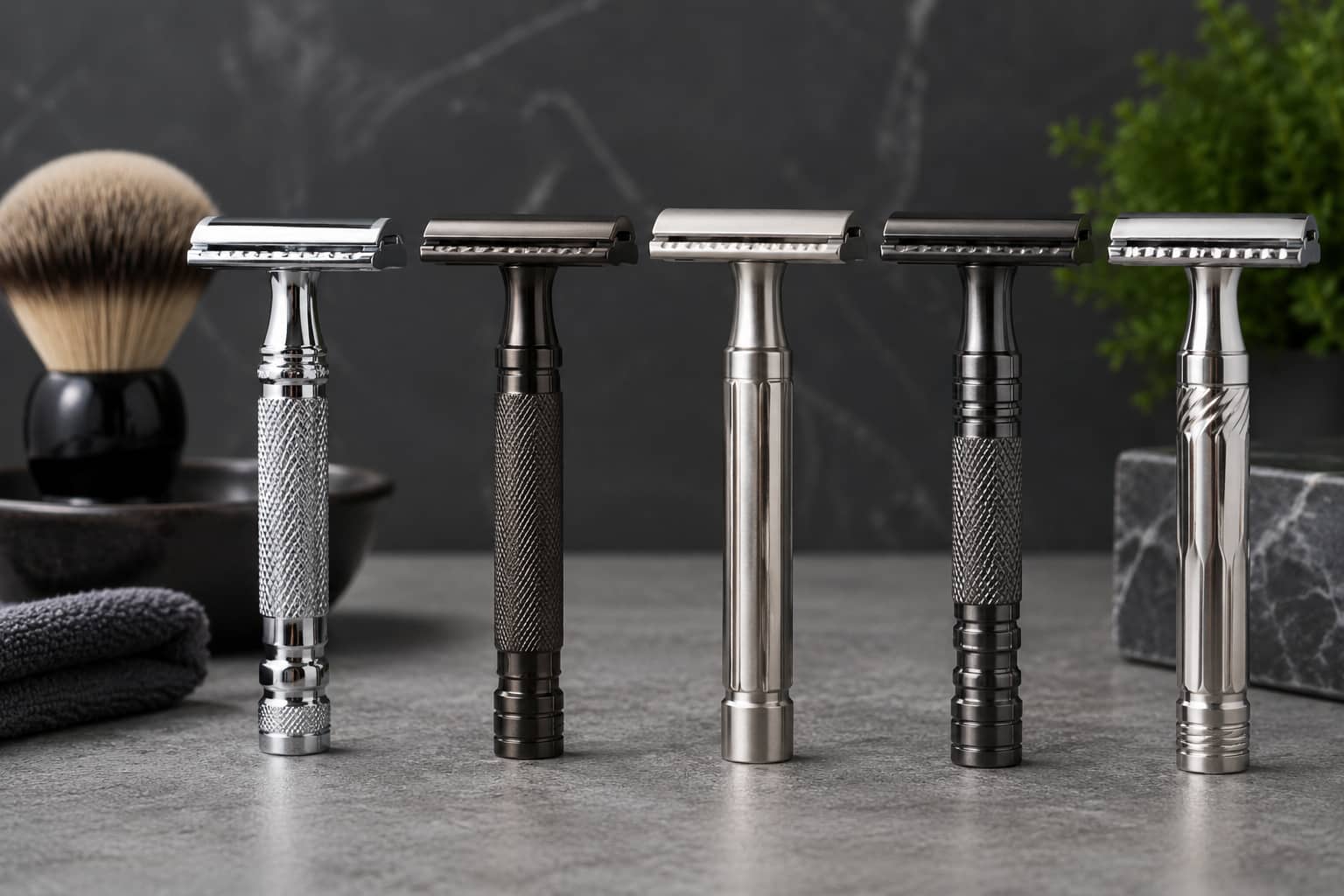
Coarse hair and safety razors have a specific relationship that most general buying guides do not address directly enough. The advice to start with a mild razor and develop technique applies universally. The advice about which razor to use once technique is established depends significantly on hair type, and for men with coarse, dense, or wiry beard hair, the recommendations are meaningfully different from what suits fine or medium hair.
Coarse beard hair requires more cutting force per hair than fine hair. It dulls blades faster. It resists mild blade gaps that a fine-haired shaver would find perfectly adequate. A shaver with coarse hair using an ultra-mild razor often needs three or four passes to achieve the closeness that a shaver with fine hair achieves in two. Those extra passes accumulate irritation. The efficiency argument for an appropriate razor level is not just about convenience. It is about skin health.
This guide covers the best safety razors for coarse hair in 2026. Every razor on this list was selected specifically for its ability to handle dense, wiry, or thick beard hair efficiently without requiring excessive passes. We cover what makes a razor suitable for coarse hair, the blade pairing strategy that maximizes performance, and the specific technique adjustments that coarse-haired shavers benefit from.
Quick Picks: Best Safety Razors for Coarse Hair 2026
| Razor | Aggressiveness | Best For |
| Merkur 37C Slant | Medium-Aggressive Slant | Wiry, dense beards |
| RazoRock Game Changer 1.05 | Aggressive | Maximum efficiency |
| Rockwell 6S (Plates 4 to 6) | Medium to Aggressive | Versatile coarse hair |
| Merkur 39C Slant | Aggressive Slant | Very coarse, dense beards |
| Karve Christopher Bradley D to F Plate | Medium-Aggressive to Aggressive | Precision coarse hair shave |
| Mühle R41 | Very Aggressive | Experienced only, maximum aggression |
| Timeless Razor 0.95 | Medium-Aggressive | Precision coarse hair |
| Feather AS-D2 with Feather Blades | Mild-Medium but Sharp | Efficiency through blade choice |
| Above the Tie S2 | Medium-Aggressive | USA precision for coarse hair |
| Parker Semi-Slant | Medium | Budget coarse hair option |
Why Coarse Hair Needs a Different Approach
Understanding the specific interaction between coarse hair and razor geometry is the foundation of making good equipment decisions for this hair type.
The Physics of Cutting Coarse Hair
Human beard hair is surprisingly strong for its diameter. The tensile strength of a single beard hair is roughly comparable to copper wire of the same cross-section. Coarse beard hair, which has a larger diameter than fine hair, requires proportionally more force to sever cleanly.
A mild razor with a small blade gap presents the blade to the hair at a shallow, well-protected angle. For fine hair this is ideal because minimal cutting force is needed and the protection prevents the blade from biting unnecessarily into the skin. For coarse hair, the same shallow protected angle means the blade may need to push against the hair before the edge engages cleanly, particularly as the blade accumulates some shaves of use.
A razor with more blade exposure presents the blade more directly to the hair. The cutting engagement is more immediate and requires less push before the edge bites. For coarse hair, this more direct engagement produces cleaner cutting per stroke and better results with fewer passes.
The Pass Count Problem
Every additional pass over already-shaved skin accumulates mechanical trauma. For a fine-haired shaver who achieves excellent closeness in two passes, a third pass adds marginal closeness at meaningful irritation cost. For a coarse-haired shaver who needs three passes with a mild razor to achieve adequate closeness, the same blade-on-skin contact is happening in every pass but for someone whose skin may already be reacting to the mechanical contact.
The correct response to this problem is not to accept additional passes as necessary. It is to use a razor geometry that achieves adequate closeness in fewer passes. A mild-to-medium or medium razor in the hands of a coarse-haired shaver with solid technique typically delivers in two passes what a mild razor requires three to achieve. The skin contact is the same or less. The result is better.
The Blade Dulling Rate
Coarse hair dulls blades faster than fine hair for the same reason that cutting hard materials dulls tools faster than cutting soft ones. A shaver with fine beard hair might get seven to eight comfortable shaves per blade. The same blade in the hands of a coarse-haired shaver might produce four to five comfortable shaves before needing replacement.
For coarse-haired shavers, changing blades more frequently is one of the most effective technique-adjacent improvements available. A fresh blade cuts coarse hair significantly more cleanly than one on its fourth shave. The how often you should change your safety razor blade guide on this site covers the specific signals of blade degradation and the frequency guidelines for different hair types.
👉 Shop Safety Razors for Coarse Hair on Amazon
What Makes a Safety Razor Suitable for Coarse Hair
Blade Gap
The blade gap is the most important geometric specification for coarse hair compatibility. A larger blade gap exposes more blade above the safety bar, which creates more direct cutting engagement with coarser hair.
For fine hair, a blade gap of 0.5mm to 0.7mm is typically sufficient. For medium hair, 0.7mm to 0.9mm covers most needs. For coarse, dense, or wiry hair, 0.9mm and above produces noticeably more efficient results. Very coarse hair may benefit from gaps of 1.0mm or more, particularly in slant razors where the geometry produces additional cutting leverage.
Blade Exposure
As covered in the aggressive vs mild safety razors guide on this site, positive blade exposure means the blade edge protrudes beyond the safety bar plane. Positive exposure increases cutting efficiency for coarse hair by ensuring the blade edge makes decisive contact rather than being recessed behind the bar.
Razors designed for efficiency in the medium-to-aggressive category typically have neutral to positive blade exposure. This combination with an appropriate blade gap produces the direct, decisive cutting action that coarse hair requires.
The Slant Advantage
Slant bar razors are disproportionately popular among coarse-haired shavers because the slant mechanism achieves cutting efficiency through a different route than simply increasing blade gap. The sliced cutting action of a slant bar razor cuts through coarse hair more efficiently than a straight-cut razor with an equivalent blade gap, with less skin trauma.
For coarse-haired shavers who also have sensitive skin, a slant razor is often the best solution. The slicing action handles coarse hair efficiently without requiring the extreme blade gaps that a straight-cut aggressive razor needs for comparable performance.
Comb Design for Coarse Hair
An open comb design is specifically beneficial for very dense or long-growth coarse hair. The teeth of an open comb guide dense hair into the blade more efficiently than a closed comb, which can struggle to channel very dense or long growth smoothly. For coarse-haired shavers who also shave infrequently or deal with multiple days of growth in each session, an open comb option is worth considering.
Best closed comb vs open comb safety razors is covered comprehensively on this site for shavers who want to understand the design difference in detail.
Best Safety Razors for Coarse Hair: Full Reviews
1. Merkur 37C Slant — Best Overall for Coarse Hair
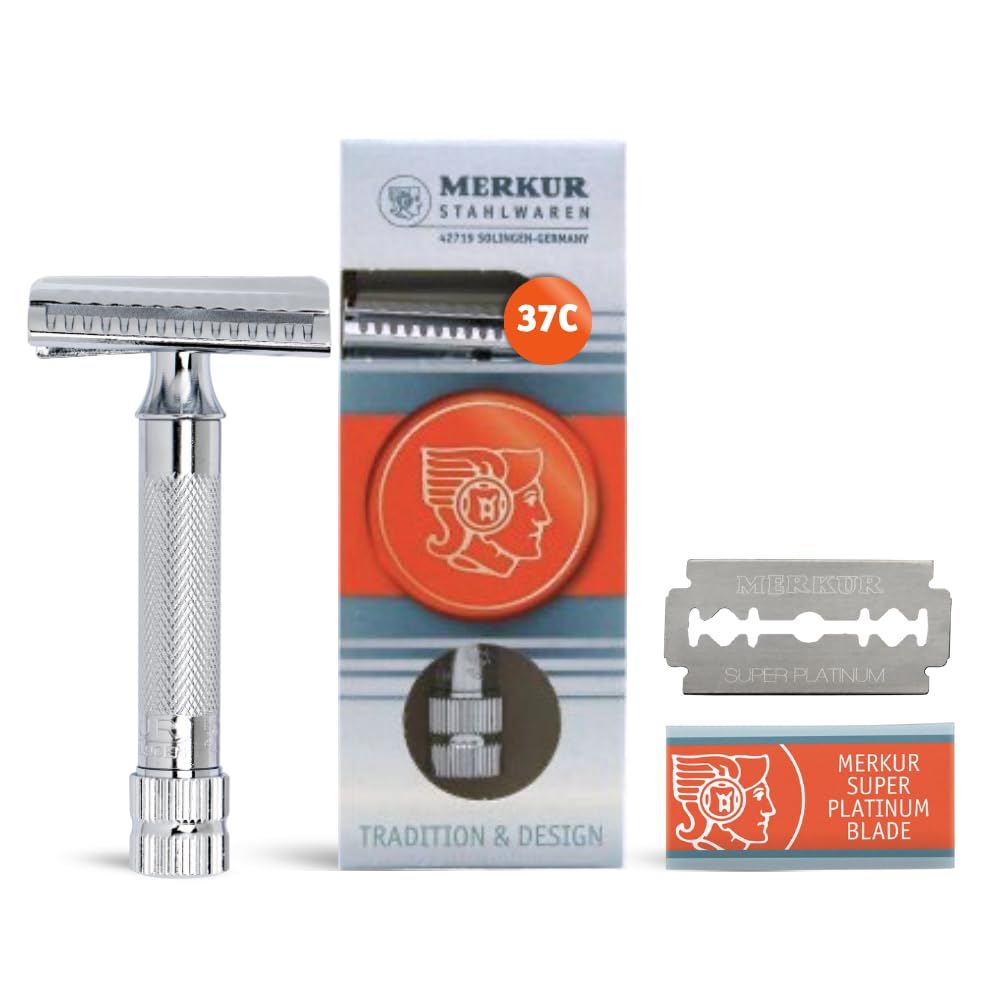
The Merkur 37C Slant is the most consistently recommended razor for coarse-haired shavers who are moving beyond mild razors. The slant bar design positions the blade at an angle to the direction of travel, creating a slicing action that cuts through coarse, wiry hair more efficiently than any straight-cut razor at an equivalent aggressiveness level.
The slant mechanism is sometimes described as the razor equivalent of a guillotine versus a straight drop. The angled blade slices rather than pushes through the hair, which requires less force per hair, causes less skin trauma, and produces cleaner cuts on coarse beard types. Many coarse-haired shavers describe the 37C as the first razor that gave them a genuinely close two-pass shave after months of struggling with three-pass mild razor shaves.
Technique adjustment for the slant: the standard 30-degree angle applies but the diagonal orientation of the blade means the angle presentation looks slightly different than on a standard razor. Use the two-step angle finding method from the safety razor shaving angles and pressure guide on this site and let the razor find its own engagement angle rather than assuming the same wrist position as your previous razor.
Specifications:
- Weight: 90g
- Handle length: 3.5 inches
- Comb type: Closed comb slant
- Material: Chrome-plated zinc alloy
- Aggressiveness: Medium-Aggressive (slant action)
Pros:
- Slant action cuts coarse hair more efficiently than equivalent gap straight-cut razors
- Medium-aggressive performance without extreme blade gap
- Less skin trauma than a straight aggressive razor at equivalent efficiency
- Trusted Merkur build quality
- Good weight for zero-pressure technique
- Widely available and well-documented in the community
Cons:
- Requires technique adjustment beyond standard safety razor approach
- Handle at 3.5 inches slightly short for some shavers
- Chrome-plated zinc rather than stainless steel
- Not suitable for beginners or shavers with undeveloped technique
👉 Check Merkur 37C Price on Amazon
2. RazoRock Game Changer 1.05 — Best Maximum Efficiency Razor
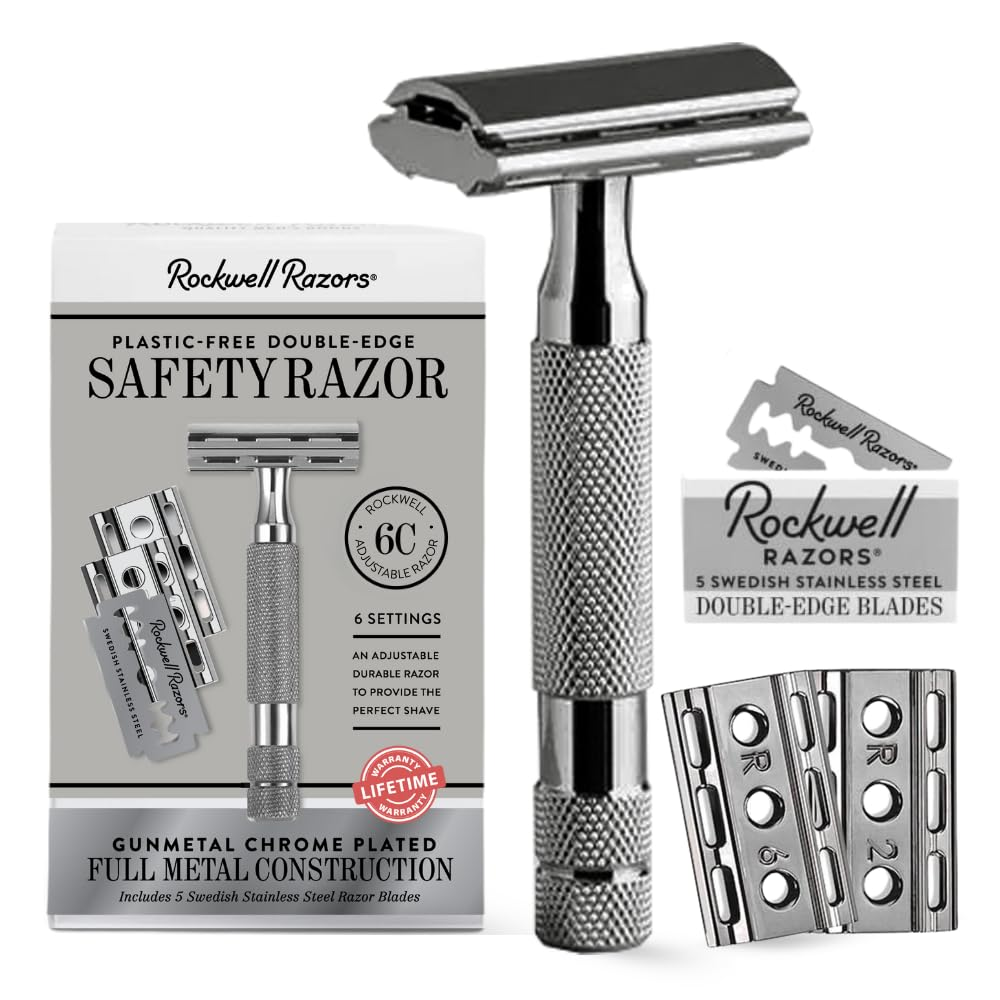
The RazoRock Game Changer 1.05 is the most aggressive configuration in the Game Changer lineup and one of the most efficient straight-cut safety razors available at a mid-range price. The 1.05mm blade gap delivers decisive cutting engagement on coarse hair that the 0.68 and 0.84 configurations cannot match in a single pass.
For experienced shavers with established technique and coarse beard hair who want maximum efficiency in the fewest passes, the Game Changer 1.05 is the most compelling mid-range option. It pairs best with medium-sharp blades like Astra Superior Platinum or Gillette Silver Blue in experienced hands. Pairing it with a very sharp blade like Feather amplifies the aggressiveness to a level that only highly experienced shavers should attempt.
Specifications:
- Weight: 85g
- Handle length: 3.5 inches
- Comb type: Closed comb
- Material: Stainless steel head, aluminum handle
- Aggressiveness: Aggressive (1.05mm gap)
Pros:
- Maximum efficiency from a straight-cut razor at mid-range price
- Stainless steel head for excellent durability
- Cuts coarse hair decisively in fewer passes
- Good weight distribution for technique
- Strong community support with extensive coarse-hair reviews
- Significant improvement over mild razors for dense beards
Cons:
- Requires fully developed technique before using safely
- Aluminum handle less premium than full stainless options
- Fixed gap means you need a different razor for non-aggressive use
- Not suitable for sensitive skin regardless of technique
👉 Check RazoRock Game Changer 1.05 Price on Amazon
3. Rockwell 6S — Best Adjustable for Coarse Hair
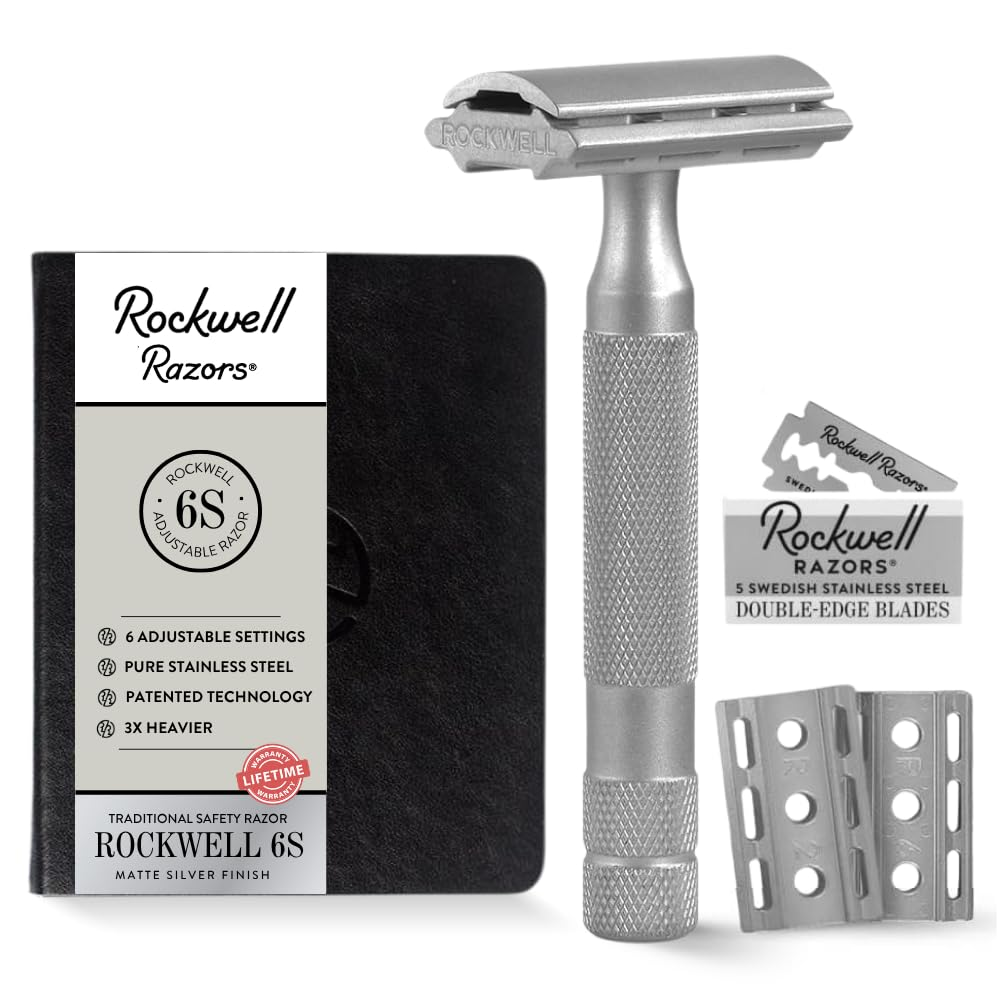
The Rockwell 6S plates 4 through 6 represent the most effective adjustable razor configuration for coarse hair management. The ability to dial up to plate 5 or 6 for heavy growth and dial back to plate 3 for daily maintenance makes the Rockwell 6S uniquely versatile for coarse-haired shavers whose growth condition varies.
Many coarse-haired shavers find that plate 5 of the Rockwell 6S is their everyday setting and plate 6 serves for two-to-three day growth catch-up shaves. The full stainless steel construction handles the intensive use of daily aggressive shaving without any durability concerns.
As covered in the best stainless steel safety razors guide on this site, the Rockwell 6S is also the best value stainless steel safety razor available. For coarse-haired shavers who want a single razor that handles every scenario, it is the most complete solution in the category.
Specifications:
- Weight: 118g
- Handle length: 3.5 inches
- Comb type: Closed comb (all plates)
- Material: Full stainless steel
- Aggressiveness: Adjustable plates 1 through 6
Pros:
- Plates 4 through 6 handle coarse hair efficiently
- Dial back for sensitive days or maintenance shaving
- Full stainless steel for lifetime durability
- Heavy weight excellent for zero-pressure technique on coarse hair
- Most versatile single razor for variable coarse hair needs
- Strong long-term value
Cons:
- Heavy at 118g, which can cause fatigue in longer shaving sessions
- Handle at 3.5 inches on the shorter side
- Plate system adds organizational requirements
- Higher upfront cost than single-configuration alternatives
👉 Check Rockwell 6S Price on Amazon
4. Merkur 39C Slant — Best for Very Coarse or Dense Beards
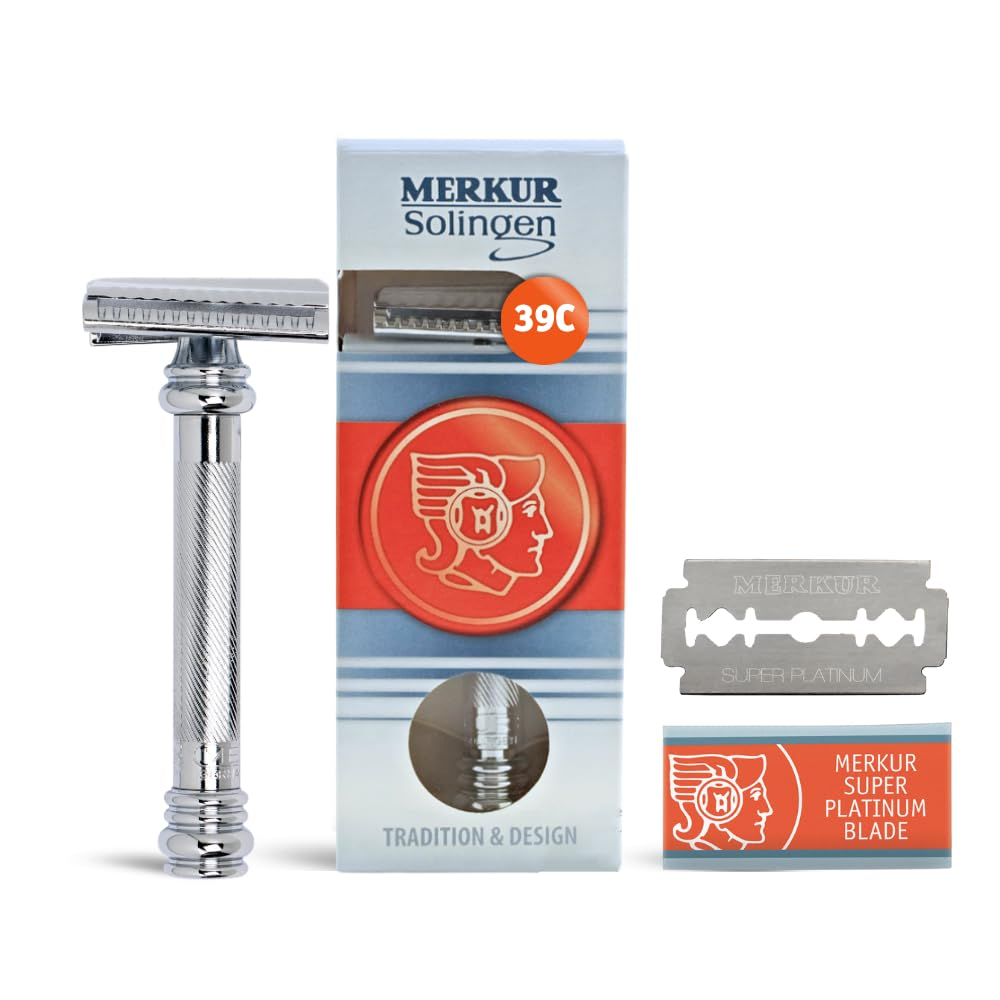
The Merkur 39C is the long-handle version of the slant bar design and the more aggressive sibling of the 37C. The additional handle length improves reach and leverage, which is beneficial for the heavier beard types that warrant this level of aggressiveness. The slant action combined with the slightly more aggressive geometry of the 39C makes it the top recommendation for men with the most demanding coarse beard types.
This razor is not for the faint-hearted or the technique-developing shaver. It rewards confidence and precision. In experienced hands with a coarse, dense beard, it produces extraordinary results in one to two passes. In inexperienced hands, it produces cuts and significant irritation.
Specifications:
- Weight: 115g
- Handle length: 4.0 inches
- Comb type: Closed comb slant
- Material: Chrome-plated zinc alloy
- Aggressiveness: Aggressive slant
Pros:
- The most aggressive slant razor from a major manufacturer
- Long handle improves reach and leverage for dense beard shaving
- Slant action handles very coarse, wiry hair decisively
- Heavy weight encourages zero-pressure technique
- Well-documented in coarse hair communities
- Maximum efficiency for the most demanding beard types
Cons:
- Requires advanced technique — not for beginners or intermediates
- Chrome-plated zinc rather than stainless steel
- Aggressive geometry punishes technique errors significantly
- Not suitable for sensitive skin
👉 Check Merkur 39C Price on Amazon
5. Karve Christopher Bradley D and E Plates — Best Premium for Coarse Hair
The Karve Christopher Bradley on its D and E plate configurations delivers precision medium-to-aggressive performance for coarse hair in a USA-machined stainless steel package. The D plate sits in the medium-aggressive range that suits most coarse-haired experienced shavers. The E plate steps up to genuinely aggressive territory for the most demanding beard types.
The precision of Karve machining means the blade alignment on the D and E plates is maintained to tolerances that produce a consistent and predictable aggressive shave. This predictability is particularly valuable for coarse-haired shavers who are working at the aggressive end of the spectrum, where small alignment variations have more significant consequences than in mild configurations.
Full details on the Karve Christopher Bradley are in the best premium safety razors worth the investment and best safety razors made in USA guides on this site.
Specifications:
- Weight: Approximately 85g
- Handle length: 3.5 inches standard
- Comb type: Closed comb (D plate) or open comb option
- Material: Stainless steel
- Aggressiveness: D plate: Medium-Aggressive, E plate: Aggressive
Pros:
- USA precision machining at the highest level
- Consistent and predictable aggressive performance
- Open comb option available for very dense hair
- Full stainless steel for lifetime durability
- Configurable across full aggressiveness range
- Strong resale value
Cons:
- Premium price
- Additional plates sold separately
- Handle at 3.5 inches shorter than some coarse-haired shavers prefer
- Requires established technique to use safely at aggressive settings
👉 Check Karve Christopher Bradley Price on Amazon
6. Mühle R41 — Most Aggressive Widely Available Razor
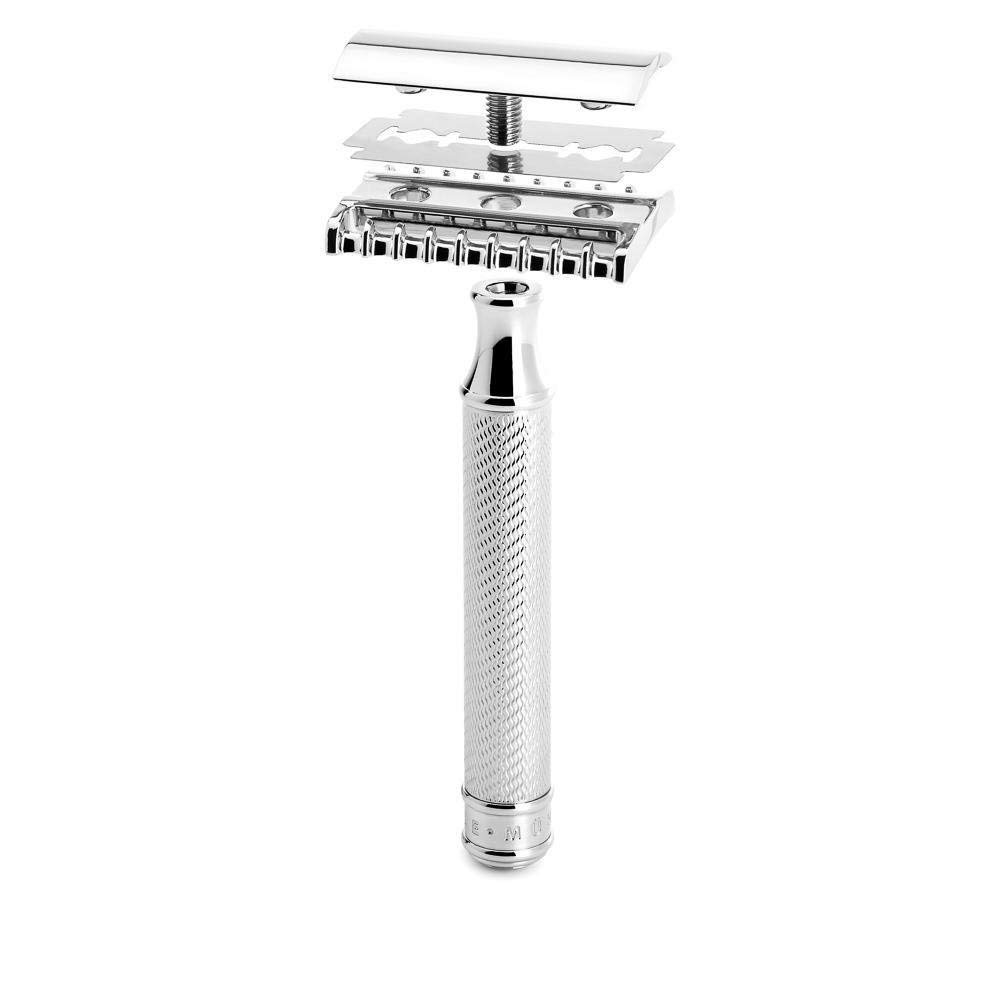
The Mühle R41 is one of the most aggressive safety razors available from a mainstream manufacturer. It has a large blade gap, strong positive blade exposure, and a head geometry that produces a shave experience that experienced users describe as intense. For coarse-haired shavers who have tried everything up to medium-aggressive and still feel they need more, the R41 is the natural next step.
It is not a razor for anyone without a solid foundation of technique and a clear understanding of how aggressive razors punish errors. Used correctly by an experienced shaver with coarse hair, it is extraordinarily efficient. Used incorrectly, it produces the worst shave in the user’s experience.
Specifications:
- Weight: 79g
- Handle length: 3.9 inches
- Comb type: Open comb
- Material: Chrome-plated brass head
- Aggressiveness: Very Aggressive
Pros:
- Among the most aggressive razors from a major manufacturer
- Open comb handles very dense hair effectively
- Good handle length for comfortable positioning
- Handles the most demanding coarse beard types
- Well-documented in experienced shaving communities
- Chrome-plated brass offers good durability
Cons:
- Very aggressive — for experienced shavers only
- Highly unforgiving of any technique errors
- Not suitable for sensitive skin regardless of experience level
- Open comb requires specific technique adjustment
👉 Check Mühle R41 Price on Amazon
7. Timeless Razor 0.95 — Best Premium Fixed for Coarse Hair
The Timeless Razor 0.95 is the medium-aggressive configuration from USA manufacturer Timeless Razor and the top fixed-geometry premium recommendation for coarse-haired shavers who have identified exactly what they want from a daily driver. The precision machining ensures that the 0.95mm gap delivers identical performance on every shave without variation.
For coarse-haired shavers who have established that a medium-aggressive fixed geometry is their permanent preference, the Timeless 0.95 delivers that preference with the precision and durability of premium USA stainless steel manufacturing. Full details are in the best stainless steel safety razors and best safety razors made in USA guides on this site.
Specifications:
- Weight: 82g
- Handle length: 3.5 inches
- Comb type: Closed comb
- Material: Full stainless steel
- Aggressiveness: Medium-Aggressive (0.95mm gap)
Pros:
- USA precision machining with exceptional tolerance consistency
- Full stainless steel for lifetime durability
- Delivers consistent medium-aggressive performance on every shave
- Excellent for coarse-haired daily shavers who know their preference
- Clean minimalist aesthetic
- Works with all standard DE blades
Cons:
- Fixed gap requires a separate mild razor for variety
- Premium price
- Handle at 3.5 inches on the shorter side
- Requires established technique
👉 Check Timeless Razor 0.95 Price on Amazon
8. Parker Semi-Slant — Best Budget Option for Coarse Hair
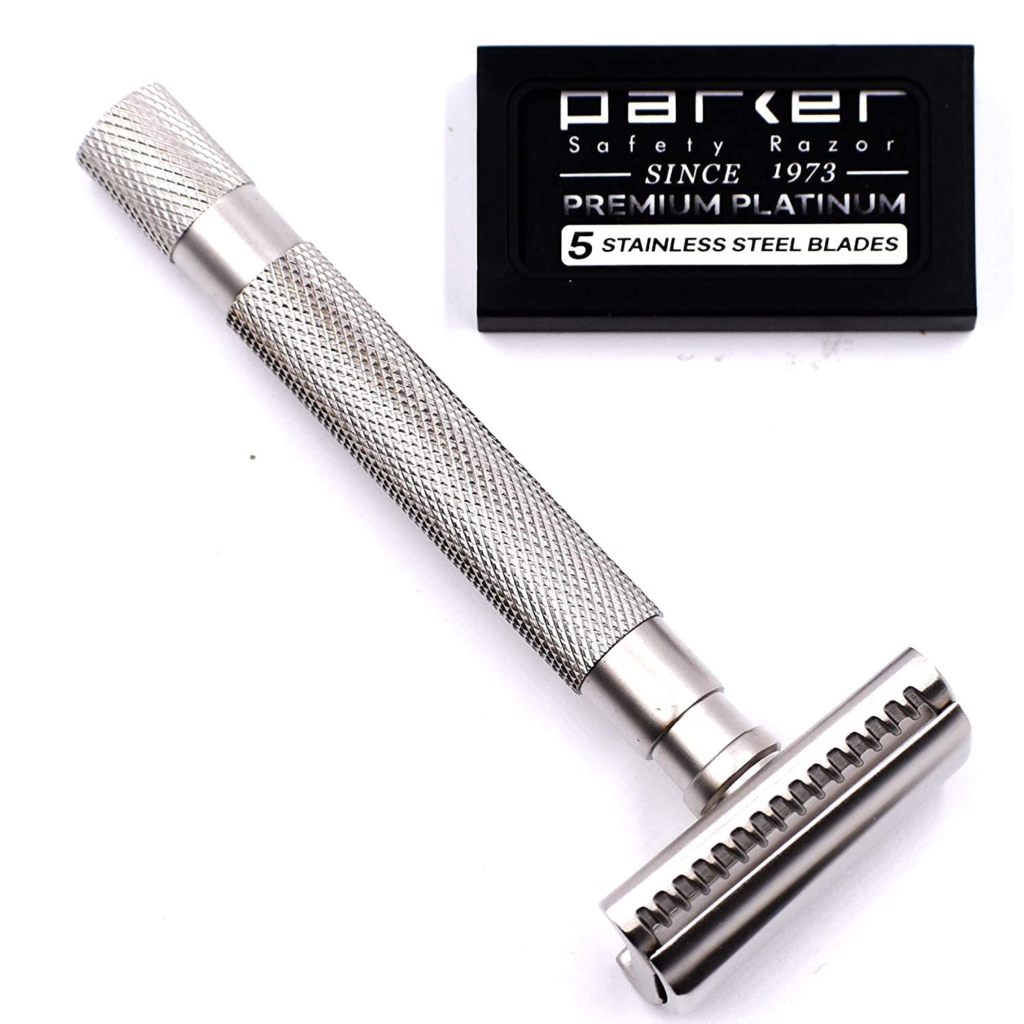
The Parker Semi-Slant is the budget-friendly entry into slant bar shaving for coarse-haired shavers who want to explore the slant advantage without a significant investment. It uses a modest slant angle rather than the full slant of the Merkur 37C and 39C, which produces a mild version of the slicing action at lower aggressiveness than the Merkur options.
For coarse-haired shavers who have been using a mild straight-cut razor and want to experiment with the slant concept at minimal cost before committing to a higher-investment slant razor, the Parker Semi-Slant is the most practical entry point.
Specifications:
- Weight: 85g
- Handle length: 3.5 inches
- Comb type: Closed comb semi-slant
- Material: Chrome-plated brass
- Aggressiveness: Medium
Pros:
- Budget entry into slant bar shaving
- Semi-slant produces efficiency improvement over straight-cut mild options
- Good weight for technique development
- Parker brass construction adequate for regular use
- Low financial risk for exploring slant format
- Works with all standard DE blades
Cons:
- Semi-slant less efficient than full slant options
- Build quality below Merkur alternatives
- Fixed medium aggressiveness may not satisfy very coarse beards
- Not a long-term keeper for most advanced shavers
👉 Check Parker Semi-Slant Price on Amazon
Best Blade Pairings for Coarse Hair
Blade choice matters significantly for coarse hair management. Here are the top pairings:
| Blade | Sharpness | Best Razor Pairing | Notes |
| Feather New Hi-Stainless | Very Sharp | Mild-Medium razors | Compensates for mild geometry on coarse hair |
| Polsilver Super Iridium | Sharp | Medium razors | Best all-round coarse hair blade |
| Astra Superior Platinum | Sharp | Medium-Aggressive razors | Most affordable coarse hair blade |
| Gillette Silver Blue | Medium-Sharp | Aggressive razors | Smooths aggressiveness slightly |
| BIC Chrome Platinum | Medium-Sharp | Medium razors | Budget coarse hair option |
| Shark Super Stainless | Medium-Sharp | Medium razors | Budget alternative |
The key principle for coarse hair blade pairing is counterintuitive to some: a sharper blade in a milder razor often outperforms a softer blade in a more aggressive razor for the same result with less skin trauma. A Feather blade in a Merkur 34C can achieve closeness on coarse hair that requires a much more aggressive razor with a medium blade. This is worth experimenting with before investing in an aggressive razor.
👉 Shop Safety Razor Blades for Coarse Hair on Amazon
Technique Adjustments for Coarse Hair
Longer Pre-Shave Preparation
Coarse hair benefits from longer warm water preparation than fine hair. The thicker, harder hair shaft resists hydration more than fine hair. Spending five minutes rather than two or three with a warm wet towel before shaving, or shaving at the end of a longer warm shower, produces meaningfully softer coarse hair that cuts more cleanly and requires less blade force.
Rich, Quality Lather
Quality lather is important for all safety razor shaving but its impact is amplified for coarse hair. Thick, glycerin-rich lather continues to hydrate the hair shaft during the shave, progressively softening each hair between the lather application and the moment the blade contacts it. Low-quality lather, which provides minimal glycerin and hydration, leaves coarse hair at its hardest when the blade arrives.
Blade Changes More Frequently
As noted above, coarse hair dulls blades faster than fine hair. For coarse-haired shavers, the standard blade change interval should be shortened. If a fine-haired shaver changes blades every six shaves, a coarse-haired shaver should consider every four. The cost of more frequent changes is minimal. The shave quality improvement from a consistently fresh blade on coarse hair is significant.
Patience With Pass Count
Even with the right razor, coarse hair may occasionally need three passes for a very close result on specific areas. The inner chin, the upper neck, and the jaw are the most common areas where coarse-haired shavers find that two passes leave a degree of roughness. Accepting this and adding a targeted third pass on specific areas rather than a full third pass over the entire face reduces overall skin contact while addressing the problem areas.
AMAZON AFFILIATE DISCLAIMER
This post contains affiliate links. If you purchase through our links, we may earn a small commission at no extra cost to you.
Frequently Asked Questions
What makes a safety razor better for coarse hair?
A larger blade gap, positive blade exposure, and either a more aggressive straight-cut geometry or a slant bar design all improve cutting efficiency on coarse hair. These features ensure the blade engages decisively with each hair rather than requiring multiple attempts to sever it cleanly.
Should I use an aggressive razor if I have coarse hair?
Not necessarily, at least not initially. A slant bar razor like the Merkur 37C achieves high efficiency on coarse hair through its slicing mechanism rather than extreme blade gap, which makes it less aggressive on skin than a straight-cut razor of equivalent efficiency. A sharper blade in a mild-to-medium razor is another route to coarse hair efficiency that keeps aggressiveness moderate. True aggressive razors should wait until technique is thoroughly established.
What is the best blade for coarse beard hair?
Polsilver Super Iridium and Feather New Hi-Stainless are the top recommendations for coarse hair. Both are sharp enough to cut coarse hair decisively in each stroke. Feather blades in a mild or medium razor are particularly effective for coarse-haired shavers who want efficiency without stepping up to aggressive razor geometry.
How often should I change blades if I have coarse hair?
Every three to five shaves rather than the standard five to seven is the recommendation for coarse-haired daily shavers. The harder hair dulls the blade edge faster, and a blade that is past its peak produces noticeably worse results on coarse hair than on fine hair. Changing more frequently is the most cost-effective improvement available.
Is the Mühle R41 too aggressive for coarse hair shavers?
The R41 is appropriate for coarse-haired shavers with several months of safety razor experience and well-developed technique. It is not appropriate for beginners regardless of beard coarseness. Many coarse-haired shavers find the Merkur 37C or 39C slant to be more efficient and less risky than the R41 at equivalent shave quality. Try slant and medium-aggressive options before committing to the R41 level of aggressiveness.
Can I use a safety razor for a coarse beard if I have sensitive skin?
Yes. The slant razor approach is specifically well-suited for coarse hair combined with sensitive skin because it achieves coarse hair efficiency through blade angle rather than extreme blade exposure, which reduces skin trauma compared to aggressive straight-cut razors. The Merkur 37C is the most commonly recommended solution for this specific combination.
Does blade brand matter more for coarse hair than fine hair?
Yes. The difference between a sharp blade like Polsilver and a mild blade like Derby Extra is felt more acutely on coarse hair because the cutting demand is higher. On fine hair, a medium blade cuts adequately. On coarse hair, the same medium blade may struggle on later shaves in a blade’s life cycle. Investing in sharper blade brands and changing more frequently has a larger impact on shave quality for coarse hair than for fine hair.